Karl Marx; Friedrich Engels · 1848
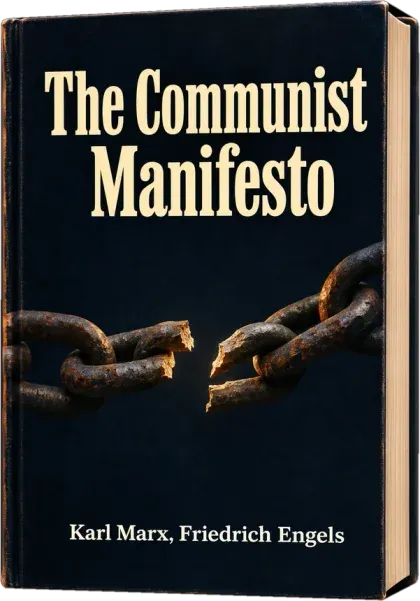
The Communist Manifesto
Early in 1848, a German manuscript goes to London to be printed. The Communist League has asked Karl Marx and Friedrich Engels to set down what Communists believe, and the two men begin with a class that has already made a revolution. The bourgeoisie has broken the power of feudal lords, put machinery to work on a prodigious scale and bound distant ports to the fortunes of a single factory. Yet a warehouse can be full to its rafters on the very morning its workers are turned into the street. Anyone who has depended on a wage knows what a closed gate means. How has a society acquired the power to make so much and so little power to command its own plenty?
- Reading time
- About 51 min
- With the voice
- 1 h 29 min
- Length
- 13,181 words · 10 chapters
- Level
- C2 CEFR
Read the opening · Part 1, Chapter 1 · 8 min
“The history of all hitherto existing society is the history of class struggles.”
The first minutes of Part 1, Chapter 1, the way the Lightkeeper app reads it: one line of words past an amber letter, with the voice. Switch to Page to see the whole paragraph.
End of the opening
Part 1, Chapter 1 goes on in the app.
You caught 0 gems. The rest of the book waits in the app.
Text: Karl Marx; Friedrich Engels. Tap the ribbon to pause; tap while a line shimmers to catch it.
Who’s who
The Communist Manifesto characters
-
Karl Marx
Marx co-writes the Communist League’s programme. He seeks to show how the way people produce their livelihoods sets classes in conflict and gives workers a common interest in emancipation.
-

Friedrich Engels
Engels co-writes the Manifesto and later helps Samuel Moore prepare its English translation. In his preface and notes, he wants readers to understand what the programme meant to the workers who first called themselves Communists.
In the app you can talk to one of the characters. They answer from the page you’re on, so the story ahead stays yours to find. How it works
What happens
The Communist Manifesto summary
Spoilers below.
A Name for the Pamphlet
In 1847 the Communist League asked Karl Marx and Friedrich Engels for a programme. Early the next year their German manuscript went to London for printing. The name on its cover belonged already to working people who meant to change society from the foundations. They had chosen it for themselves. Who else, after all, was to secure their emancipation? There would come a June when the Paris workers went down to defeat, a trial at Cologne, prison sentences and the dissolution of the League. The little book might well have perished with the body that commissioned it. Yet years afterward, in the International, workers of differing convictions would learn from their common struggles to read it afresh. Preparing the English translation with Samuel Moore, Engels supplied notes and gave Marx the chief credit for its governing idea. Some proposals had aged. The two friends had agreed to let the document stand.
Inside the book
10 chapters
- Preface
- Introduction
- Part 1, Chapter 1 From lord and serf to capitalist and worker, how has the struggle between classes changed?
- Part 1, Chapter 2 If Communists share the interests of the whole working class, what sets them apart?
- Part 1, Chapter 3
- Part 2, Chapter 1
- (A) What moves a defeated aristocracy to take up its pen in the name of the workers?
- (B) Between the bourgeoisie and the proletariat, how much room is left for the small proprietor?
- (C) French socialism crosses into Germany, where the bourgeoisie is still fighting for power.
- Part 2, Chapter 2 How far will bourgeois reformers go to mend a society they mean to preserve?
- Part 2, Chapter 3 What future could Saint-Simon, Fourier and Owen imagine while the working class was still taking shape?
- Part 2, Chapter 4 From France to Germany, how do Communists choose allies when they share only part of the road ahead?
Lines worth keeping
The Communist Manifesto quotes
The history of all hitherto existing society is the history of class struggles. Freeman and slave, patrician and plebeian, lord and serf, guildmaster and journeyman, in a word, oppressor and oppressed, stood in constant opposition to one another, carried on an uninterrupted, now hidden, now open fight, that each time ended, either in the revolutionary reconstitution of society at large, or in the common ruin of the contending classes.
All that is solid melts into air, all that is holy is profaned, and man is at last compelled to face with sober senses his real conditions of life and his relations with his kind.
What the bourgeoisie therefore produces, above all, are its own grave diggers.
In place of the old bourgeois society with its classes and class antagonisms we shall have an association in which the free development of each is the condition for the free development of all.
The proletarians have nothing to lose but their chains. They have a world to win. Workingmen of all countries unite!
Thus, Socialism was, in 1847, a middle class movement, Communism a working class movement. Socialism was, on the Continent at least, “respectable”; Communism was the very opposite. And as our notion, from the very beginning was, that “the emancipation of the working class must be the act of the working class itself,” there could be no doubt as to which of the two names we must take.
ThemesClass struggle and political powerCapital and collective labourOverproduction and commercial crisisWorkers’ self-emancipationInternational solidarityThe future of property
Questions
Before you start
How long does it take to read The Communist Manifesto?
The Communist Manifesto is 13,181 words. At an average adult pace for fiction, about 260 words a minute (Brysbaert, 2019), that’s about 51 min. With the voice at normal speed it takes 1 h 29 min, and about 59 min at 1.5×.
Is there a The Communist Manifesto audiobook with the text?
Yes. In Lightkeeper the voice reads while the words move past one amber letter, so your eyes and ears stay on the same word. Speed it up or slow it down and the voice keeps pace. The opening of Part 1, Chapter 1 is on this page to try.
What reading level is The Communist Manifesto?
C2 on the CEFR scale, which runs from A1, the easiest, to C2. The language is demanding; reading along with the voice helps keep the thread.
Read all of The Communist Manifesto in Lightkeeper
With the voice, the gems to find and the characters to talk to. On iPhone and Android.
More from the shelf