
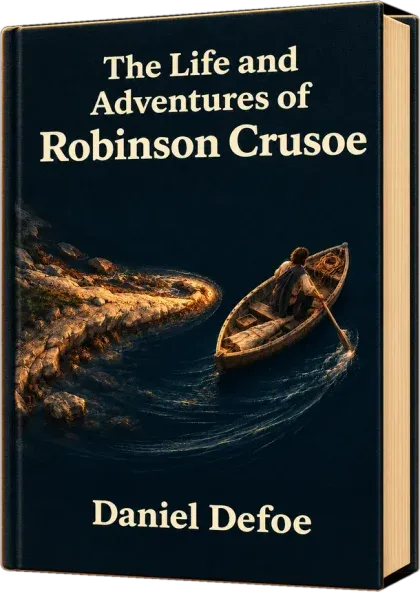
Daniel Defoe · 1719
The Life and Adventures of Robinson Crusoe
Robinson Crusoe leaves York with his father’s counsel in his ears and takes ship at Hull without so much as a farewell. One storm is enough to make him promise to go home. One bowl of punch is enough to make him forget it. He has a head for trade, a taste for the sea, and a dangerous gift for finding good reasons to do whatever he already desires. Even prosperity in Brazil cannot keep him ashore. Then a wave sets him down alone on an island, with salt in his throat and all the tools he needs aboard a broken ship offshore. What can a man make of his life when the tide is coming in and there is nobody left to give him a hand?
- Reading time
- About 7 h 45 min
- With the voice
- 10 h 42 min
- Length
- 121,104 words · 20 chapters
- Level
- C1 CEFR
Read the opening · Chapter 1 · 7 min
“I was born in the year 1632, in the city of York, of a good family, though not of that country, my father being a…”
The first minutes of Chapter 1, the way the Lightkeeper app reads it: one line of words past an amber letter, with the voice. Switch to Page to see the whole paragraph.
End of the opening
Chapter 1 goes on in the app.
You caught 0 gems. The rest of the book waits in the app.
Text: Daniel Defoe. Tap the ribbon to pause; tap while a line shimmers to catch it.
Who’s who
The Life and Adventures of Robinson Crusoe characters
-

Robinson Crusoe
A York merchant’s third son, Crusoe wants to go to sea despite his father’s hopes for him in the law. He has a trader’s eye for opportunity and a craftsman’s patience once necessity sets him to work.
First named in Chapter 1
-
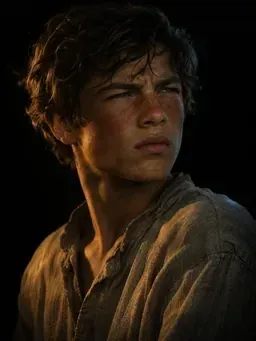
Xury
A boy who rows on the fishing trips from Sallee, Xury throws in his lot with Crusoe. He goes ashore for water and game when both their lives depend on what he can bring back.
First named in Chapter 2
-
the Portuguese captain
He takes Crusoe and Xury aboard off the African coast and carries them to Brazil. He takes a lasting interest in helping Crusoe establish himself as a planter.
First named in Chapter 3
-
Poll
Crusoe catches this young parrot while exploring the island. Poll learns his keeper’s name so well that he can startle the very man who taught him to speak.
First named in Chapter 8
-
Friday
Taken prisoner in battle, Friday seizes his chance to escape when his captors bring him ashore. An able canoeist with an inquiring mind, he longs to see his country again and wants Crusoe to know it too.
First named in Chapter 14
-
Friday’s father
A captive bound in a canoe, he fears the knife even as it comes to cut him loose. His knowledge of the mainland gives him a part in the islanders’ plans.
First named in Chapter 15
-
the Spaniard
A shipwrecked European brought to the island as a prisoner, he wants to help the companions he left on the mainland. He has the good sense to count how many mouths there will be to feed.
First named in Chapter 12
-
the captain
An English captain put ashore by his mutinous crew, he hopes to regain his ship. He knows his men well enough to tell which might rally to him if offered mercy.
First named in Chapter 2
In the app you can talk to 7 of the characters. They answer from the page you’re on, so the story ahead stays yours to find. How it works
What happens
The Life and Adventures of Robinson Crusoe summary
Spoilers below.
A Passage for Nothing
My father had designed me for the law, and had undertaken to put me in the way of living well in York, where I was born, the third son of a merchant. He spoke to me very tenderly upon the subject. I believe I felt every word of it while I was in the room with him. Yet happening afterwards to be at Hull, and a companion offering me a passage to London in his father’s ship without the expense of a farthing, I went aboard. I could not have written three lines to my mother without being obliged to tell her where I was going, so I spared myself that trouble too.
In the first rough weather I would have given the world to be at home, and promised God very heartily to go there. A smooth sea and a bowl of punch made an end of that promise. At Yarmouth Roads we had a storm that put even the old hands to their prayers. A boat fetched us off, and we had scarcely got clear when our ship went down. The master advised me to take the road to York. I took the road to London, for I could face another shipwreck more easily than I could face my acquaintance and own that my father had been right.
A good captain carried me to Guinea, taught me something of navigation, and enabled me to turn forty pounds in goods into near three hundred. After his death I tried the same voyage again. This time a rover took us, and for about two years at Sallee I went at another man’s bidding, with leisure enough to consider what a precious thing it was to go where one pleased. At last my master sent me fishing in a well-stocked longboat. I threw his kinsman Ismael into the water, left him to swim for shore, and demanded of the boy Xury whether he would stand by me. He promised to go wherever I went.
Southward we crept along the African coast. When our water failed, Xury came back from shore with water and game besides. We killed a lion, and it cost us the better part of a day to get his coat off him. I dried it on the cabin roof and afterwards slept on it. People who could exchange no words with us gave us food and drink, and at length a Portuguese captain took us both aboard for Brazil. Xury agreed to go with him upon a promise of freedom in ten years if he became a Christian. My own freedom had been restored to me in an instant. I settled the terms of the boy’s with considerably more patience.
Inside the book
20 chapters
- Chapter 1
- Chapter 2 Crusoe has money in his pocket and passage to Guinea, but what use is a gentleman aboard ship?
- Chapter 3 Crusoe steers south in hope of a sail, while Xury keeps a wary eye on the people ashore.
- Chapter 4 By morning the sea has carried the wreck closer to shore. Can Crusoe reach her while the tide is low?
- Chapter 5 Crusoe opens his journal with the day he washed ashore and the first question he faced: where to sleep.
- Chapter 6 Crusoe can now walk to the wreck at low tide, but how much of her cargo lies buried in the sand?
- Chapter 7 Ten months on the island have taught Crusoe how to live by the shore, but what grows farther up the creek?
- Chapter 8 Beyond his bower, Crusoe spies land far out to the west. Is it another island or the mainland?
- Chapter 9 Rain keeps Crusoe indoors, where his pupil Poll may yet give him the one thing he lacks: a voice in reply.
- Chapter 10 One canoe still lies where Crusoe carved it. Will his second carry him out to sea?
- Chapter 11 At Crusoe’s table the dog has the place of honour, but which of his subjects may speak to the king?
- Chapter 12 Crusoe’s goats spare him many a day’s hunting, but where can he keep a whole flock out of sight?
- Chapter 13 After twenty-three years, Crusoe could grow old listening to Poll, if only he knew the shore was his alone.
- Chapter 14 All is quiet at home, yet Crusoe keeps thinking of the wreck: what could be worth another voyage?
- Chapter 15 Crusoe takes Friday hunting, but when the shot rings out, why does Friday feel beneath his own waistcoat?
- Chapter 16 Friday longs to see his people again, so why does he look so grave when Crusoe offers him a boat?
- Chapter 17 Across the water, sixteen shipwrecked men barely have enough to live on. What can Crusoe do for them?
- Chapter 18 The ship signals, the beached boat gives no answer, and through his glass Crusoe sees a second boat coming.
- Chapter 19 At dawn two men swim out to the ship. What could make them beg to come aboard even if the captain hangs them?
- Chapter 20 On the snowy road, Friday faces a bear that Crusoe reckons would hardly step aside for a prince.
Lines worth keeping
The Life and Adventures of Robinson Crusoe quotes
It happened one day, about noon, going towards my boat, I was exceedingly surprised with the print of a man’s naked foot on the shore, which was very plain to be seen on the sand. I stood like one thunderstruck, or as if I had seen an apparition. I listened, I looked round me, but I could hear nothing, nor see anything; I went up to a rising ground to look farther; I went up the shore and down the shore, but it was all one; I could see no other impression but that one.
He bade me observe it, and I should always find that the calamities of life were shared among the upper and lower part of mankind, but that the middle station had the fewest disasters, and was not exposed to so many vicissitudes as the higher or lower part of mankind; nay, they were not subjected to so many distempers and uneasinesses, either of body or mind, as those were who, by vicious living, luxury, and extravagances on the one hand, or by hard labour, want of necessaries, and mean or insufficient diet on the other hand, bring distemper upon themselves by the natural consequences of their way of living; that the middle station of life was calculated for all kind of virtue and all kind of enjoyments; that peace and plenty were the handmaids of a middle fortune; that temperance, moderation, quietness, health, society, all agreeable diversions, and all desirable pleasures, were the blessings attending the middle station of life; that this way men went silently and smoothly through the world, and comfortably out of it, not embarrassed with the labours of the hands or of the head, not sold to a life of slavery for daily bread, nor harassed with perplexed circumstances, which rob the soul of peace and the body of rest, nor enraged with the passion of envy, or the secret burning lust of ambition for great things; but, in easy circumstances, sliding gently through the world, and sensibly tasting the sweets of living, without the bitter; feeling that they are happy, and learning by every day’s experience to know it more sensibly.
I found, indeed, some intervals of reflection; and the serious thoughts did, as it were, endeavour to return again sometimes; but I shook them off, and roused myself from them as it were from a distemper, and applying myself to drinking and company, soon mastered the return of those fits—for so I called them; and I had in five or six days got as complete a victory over conscience as any young fellow that resolved not to be troubled with it could desire.
As to going home, shame opposed the best motions that offered to my thoughts, and it immediately occurred to me how I should be laughed at among the neighbours, and should be ashamed to see, not my father and mother only, but even everybody else; from whence I have since often observed, how incongruous and irrational the common temper of mankind is, especially of youth, to that reason which ought to guide them in such cases—that they are not ashamed to sin, and yet are ashamed to repent; not ashamed of the action for which they ought justly to be esteemed fools, but are ashamed of the returning, which only can make them be esteemed wise men.
This was the only voyage which I may say was successful in all my adventures, which I owe to the integrity and honesty of my friend the captain; under whom also I got a competent knowledge of the mathematics and the rules of navigation, learned how to keep an account of the ship’s course, take an observation, and, in short, to understand some things that were needful to be understood by a sailor; for, as he took delight to instruct me, I took delight to learn; and, in a word, this voyage made me both a sailor and a merchant; for I brought home five pounds nine ounces of gold-dust for my adventure, which yielded me in London, at my return, almost £300; and this filled me with those aspiring thoughts which have since so completed my ruin.
When he was gone, I turned to the boy, whom they called Xury, and said to him, “Xury, if you will be faithful to me, I’ll make you a great man; but if you will not stroke your face to be true to me”—that is, swear by Muhammad and his father’s beard—“I must throw you into the sea too.” The boy smiled in my face, and spoke so innocently that I could not distrust him, and swore to be faithful to me, and go all over the world with me.
ThemesRestlessness and the longing for homeProvidence, gratitude and repentanceThe labour of survivalSolitude and companionshipFreedom, slavery and colonial ownership
Questions
Before you start
How long does it take to read The Life and Adventures of Robinson Crusoe?
The Life and Adventures of Robinson Crusoe is 121,104 words. At an average adult pace for fiction, about 260 words a minute (Brysbaert, 2019), that’s about 7 h 45 min. With the voice at normal speed it takes 10 h 42 min, and about 7 h 8 min at 1.5×.
Is there a The Life and Adventures of Robinson Crusoe audiobook with the text?
Yes. In Lightkeeper the voice reads while the words move past one amber letter, so your eyes and ears stay on the same word. Speed it up or slow it down and the voice keeps pace. The opening of Chapter 1 is on this page to try.
What reading level is The Life and Adventures of Robinson Crusoe?
C1 on the CEFR scale, which runs from A1, the easiest, to C2. The language is demanding; reading along with the voice helps keep the thread.
Read all of The Life and Adventures of Robinson Crusoe in Lightkeeper
With the voice, the gems to find and the characters to talk to. On iPhone and Android.
More from the shelf
You might read next
-
 The Adventures of Sherlock Holmes Arthur Conan Doyle 9 h 55 min · B1
-
 The Call of the Wild Jack London 3 h 5 min · B2
-
 The Hound of the Baskervilles Arthur Conan Doyle 5 h 35 min · B1
-
 The Time Machine H. G. Wells 3 h 10 min · B2
-
 The Sign of the Four Arthur Conan Doyle 4 h 10 min · B1
-
 The Thirty-Nine Steps John Buchan 3 h 45 min · B1