Booker T. Washington
Up from Slavery
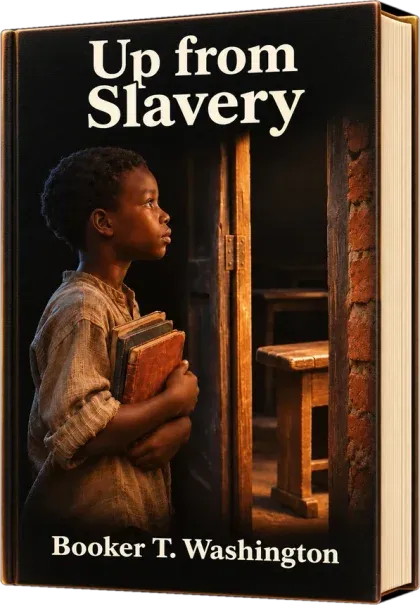
Booker carries other children’s books as far as a Virginia schoolhouse door. One look inside gives him an ambition he can scarcely explain to anyone who has always been free to enter a school. Emancipation comes, and his mother kisses him, but in West Virginia there is salt to pack before daylight, and afterward there is coal to dig. His first lesson in figures comes from the number on a barrel. Then, down in the mine, he overhears two men talking of a school called Hampton, where a fellow may earn his keep while he studies. Booker has a few people willing to help him, a long road before him, and very little money. What will it take to get him through that door?
- Reading time
- About 4 h 55 min
- With the voice
- 7 h 2 min
- Length
- 76,696 words · 17 chapters
- Level
- C1 CEFR
Read the opening · Chapter 1 · 8 min
“I was born a slave on a plantation in Franklin County, Virginia.”
The first minutes of Chapter 1, the way the Lightkeeper app reads it: one line of words past an amber letter, with the voice. Switch to Page to see the whole paragraph.
End of the opening
Chapter 1 goes on in the app.
You caught 0 gems. The rest of the book waits in the app.
Text: Booker T. Washington. Tap the ribbon to pause; tap while a line shimmers to catch it.
Who’s who
Up from Slavery characters
-
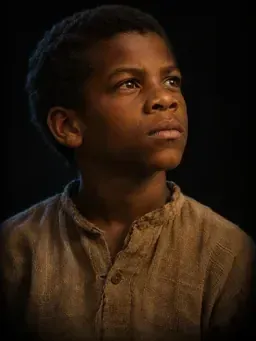
Booker T. Washington
A boy born enslaved in Virginia discovers a longing for school while carrying another child’s books. As a teacher, he wants his pupils to bring what they learn home to the people who helped send them.
First named in Chapter 2
-
Washington’s mother
A plantation cook, she prays for freedom for her children. When Booker wants to go to school, she finds him a spelling book and sews him a cap.
First named in Chapter 14
-
John
Booker’s older brother wears the roughness out of his little brother’s flax shirts and later works beside him at the salt furnace. He helps Booker pursue an education he would like to have himself.
First named in Chapter 1
-
Mrs. Viola Ruffner
Booker’s exacting employer in Malden expects him to notice every neglected corner of her house. As she comes to trust him, she makes time for his studies.
First named in Chapter 3
-
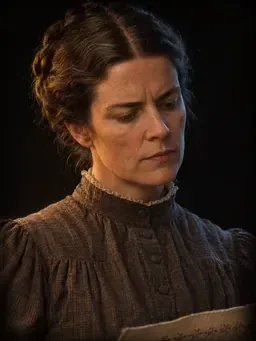
Miss Mary F. Mackie
Hampton’s head teacher has to decide what to make of a travel-worn applicant. She puts a broom in his hands and takes a close interest in how he uses it.
First named in Chapter 3
-
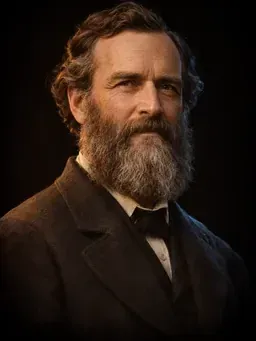
General Samuel C. Armstrong
The founder of Hampton wants young people to gain an education they can put to work in their communities. He watches the progress of the pupils Booker sends him as closely as he once watched Booker’s own.
First named in Chapter 3
-
General J. F. B. Marshall
Hampton’s treasurer sees promise in a student who owes the school sixteen dollars. He is willing to give a young teacher’s word considerable weight in a matter of money.
First named in Chapter 4
-
Fannie N. Smith
Booker’s first wife helps make their home a gathering place for teachers during the lean early years at Tuskegee.
First named in Chapter 9
In the app you can talk to 8 of the characters. They answer from the page you’re on, so the story ahead stays yours to find. How it works
What happens
Up from Slavery summary
Spoilers below.
The Schoolhouse Door
Of the day of my birth I can give no certain account. Of the floor on which I slept with my brother John and my sister Amanda, I have a distinct recollection. Our bed was a heap of rags in a Virginia cabin where my mother did the cooking for the plantation. My brother, who had a very tender feeling for me, used to wear my new flax shirts for several days to take the worst of the roughness out of them. Among my duties was that of carrying books for one of the young people of the great house. At the schoolhouse door I could see a whole company of boys and girls engaged in the very occupation which, of all occupations on earth, seemed to me the most desirable.
During the war I heard my mother praying that freedom might come to her and her children. News travelled through the quarters by means which would have astonished the people in the great house. Grief travelled between the two houses, too. When Mars’ Billy was killed, people who had tended him as a baby remembered the young man who had sometimes spoken up for one of them when a beating was at hand. At last we were called together and a stranger read from a paper. My mother bent down and kissed us. She had lived to see the answer to her prayer. After the singing there came a quiet time, in which men and women who had never owned even the hours of their day had to consider where they would sleep and how they would feed their children.
We went to Malden, in West Virginia, to join my stepfather. John and I worked at a salt furnace, where I learned to recognize the number on our barrels long before I could read a sentence. My mother somehow procured a spelling book, and with its assistance I made the acquaintance of most of the alphabet. When our people got a school, I took lessons after work until I could obtain leave to attend by day. My mother made me a cap, and on the day of the roll call I supplied myself with a surname. Hearing the other children give two names, I decided upon Washington. In time I learned that my mother had named me Booker Taliaferro, and I was glad to put back what belonged to her.
Inside the book
17 chapters
- Preface
- Introduction
- Chapter 1 Washington remembers the Virginia cabin where he was born into slavery, but even his birth date eludes him.
- Chapter 2 What does freedom feel like the first time you choose your own name or walk away from the plantation?
- Chapter 3 In the dark of a coal mine, a boy edges closer to two men talking about a school in Virginia.
- Chapter 4 As Hampton empties for the summer, Washington pins his hopes of getting home on a secondhand coat.
- Chapter 5 What did a few words of Latin promise the people crowding into Southern classrooms after emancipation?
- Chapter 6 A campaign to move West Virginia’s capital puts Washington on the road and a political career within reach.
- Chapter 7 The men planning a school in Tuskegee expect a white teacher, and General Armstrong has someone else in mind.
- Chapter 8 With a shanty and a church for classrooms, what can Washington teach that will matter outside their doors?
- Chapter 9 Christmas in Tuskegee announces itself at two in the morning with children knocking at Washington’s door.
- Chapter 10 What might Tuskegee’s students learn by raising the very buildings in which they will study?
- Chapter 11 The man who lent Tuskegee its first $250 comes to see what that money helped set in motion.
- Chapter 12 Tuskegee has a name for its new boarding hall, a sketch, and ten thousand dollars still to find.
- Chapter 13 For students too poor to pay for board at Tuskegee, a day of work could earn an evening in class.
- Chapter 14 As Washington rises to speak in Atlanta, what words will reach the Black and white listeners before him?
- Chapter 15 What did a war correspondent in the Atlanta crowd see that he had to wire to New York that day?
- Chapter 16 Eight miles from Tuskegee, Margaret Washington’s work with plantation families holds a lesson for her students.
- Chapter 17 With little strength left, General Armstrong asks to see Tuskegee once more, and the town prepares a welcome.
Lines worth keeping
Up from Slavery quotes
I have learned that success is to be measured not so much by the position that one has reached in life as by the obstacles which he has overcome while trying to succeed.
No race can prosper till it learns that there is as much dignity in tilling a field as in writing a poem.
In all things that are purely social we can be as separate as the fingers, yet one as the hand in all things essential to mutual progress.
They brought to my mind the plantation, the cabin, the slave, not the freedman in quest of education. But on the plantation and in the cabin they had never been sung as these thousand students sang them. I saw again all the old plantations that I had ever seen; the whole history of the Negro ran through my mind; and the inexpressible pathos of his life found expression in these songs as I had never before felt it.
It not only makes “a carpenter of a man; it makes a man of a carpenter.”
I asked Mr. Washington years ago what he regarded as the most important result of his work, and he replied: “I do not know which to put first, the effect of Tuskegee’s work on the Negro, or the effect on the attitude of the white man to the Negro.”
ThemesFreedom and the means to liveThe hunger for educationCraftsmanship and self-respectFamily sacrifice and mutual aidRacial cooperation and political rights
Questions
Before you start
How long does it take to read Up from Slavery?
Up from Slavery is 76,696 words. At an average adult pace for fiction, about 260 words a minute (Brysbaert, 2019), that’s about 4 h 55 min. With the voice at normal speed it takes 7 h 2 min, and about 4 h 42 min at 1.5×.
Is there a Up from Slavery audiobook with the text?
Yes. In Lightkeeper the voice reads while the words move past one amber letter, so your eyes and ears stay on the same word. Speed it up or slow it down and the voice keeps pace. The opening of Chapter 1 is on this page to try.
What reading level is Up from Slavery?
C1 on the CEFR scale, which runs from A1, the easiest, to C2. The language is demanding; reading along with the voice helps keep the thread.
Read all of Up from Slavery in Lightkeeper
With the voice, the gems to find and the characters to talk to. On iPhone and Android.
More from the shelf