
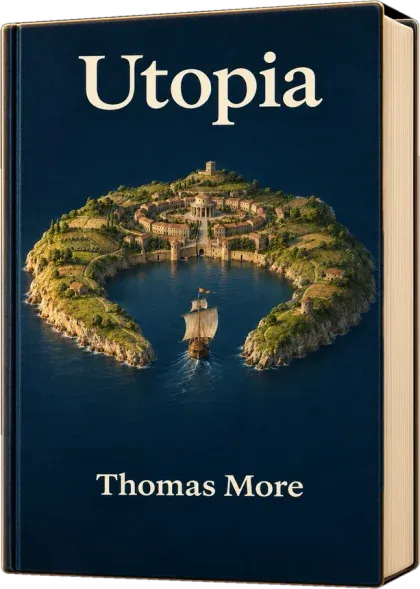
Thomas More
Utopia
In Antwerp, while the king’s business stands still, Peter Giles introduces Thomas More to a Portuguese traveller who gave his estate to his brothers and went to sea. Here, More thinks, is a man fit to advise a prince. Raphael Hythloday has his doubts. He remembers a dinner in England, and a lawyer who marvelled that there should be so many thieves left in a country so diligent in hanging them. Raphael had ventured to ask what became of a family when its land went to sheep. The gentlemen at table had little use for his answer until they heard what the Cardinal thought of it. What good can an honest man do at a prince’s elbow if everyone is watching the prince’s face?
- Reading time
- About 2 h 40 min
- With the voice
- 3 h 50 min
- Length
- 42,196 words · 9 chapters
- Level
- C2 CEFR
Read the opening · Discourses of Raphael Hythloday, of the Best State of a Commonwealth · 8 min
“Henry VIII., the unconquered King of England, a prince adorned with all the virtues that become a great monarch, having…”
The first minutes of Discourses of Raphael Hythloday, of the Best State of a Commonwealth, the way the Lightkeeper app reads it: one line of words past an amber letter, with the voice. Switch to Page to see the whole paragraph.
End of the opening
Discourses of Raphael Hythloday, of the Best State of a Commonwealth goes on in the app.
The rest of the book waits in the app.
Text: Thomas More. Tap the ribbon to pause.
Who’s who
Utopia characters
-
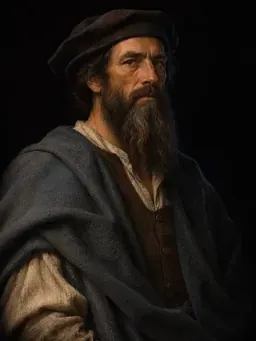
Raphael Hythloday
A Portuguese traveller schooled in philosophy, Raphael gives his estate to his brothers and sails with Americus Vesputius. He wants a hearing for what he has learned abroad and prizes the freedom to speak his mind.
First named in Discourses of Raphael Hythloday, of the Best State of a Commonwealth
-

Thomas More
Henry VIII’s ambassador in Flanders, More is eager to hear how people live in distant countries. He hopes a man of independent judgment can help a ruler do less harm.
First named in Discourses of Raphael Hythloday, of the Best State of a Commonwealth
-
Peter Giles
More’s friend in Antwerp brings him to meet Raphael, knowing his appetite for travellers’ tales. Peter would like a prince to put Raphael’s experience to public use.
First named in Discourses of Raphael Hythloday, of the Best State of a Commonwealth
-
John Morton
An English cardinal and royal adviser, Morton gives Raphael a hearing at his dinner table. When the talk turns to hanging thieves, he wants to know what penalty his guest would put in its place.
First named in Discourses of Raphael Hythloday, of the Best State of a Commonwealth
-
the Counsellor
A lawyer dining with Morton takes pride in the severity of English justice. The persistence of theft puzzles him, and he is ready to defend the law against Raphael’s objections.
First named in Discourses of Raphael Hythloday, of the Best State of a Commonwealth
-
Utopus
The conqueror who gives Utopia his name sets soldiers and inhabitants to work digging the channel that makes it an island. He seeks religious peace among people who worship differently.
First named in Discourses of Raphael Hythloday, of the Best State of a Commonwealth
In the app you can talk to 2 of the characters. They answer from the page you’re on, so the story ahead stays yours to find. How it works
What happens
Utopia summary
Spoilers below.
A Place at Table
The King’s business in Flanders came to a stand, and I had the good fortune to spend some days in Antwerp with my friend Peter Giles. It was through Peter that I met Raphael Hythloday, a Portuguese who had made over his estate to his brothers and sailed three times with Americus Vesputius. Peter thought it a pity that no prince enjoyed the benefit of such a man’s experience. Raphael, who had gone a considerable way to dispose of his own affairs, showed little appetite for those of a king.
He had once dined in England with Cardinal Morton. A lawyer at table wondered how thieves could flourish where so many went to the gallows. Raphael begged him to consider a family turned off its holding to make pasture for sheep. They sold their few goods dear or cheap as hunger dictated. When the last pot was gone, what trade had England left them? Morton asked what he would do with a thief. Among the Polylerits, said Raphael, his goods went to repay the injured man, and he lived to labour for the public. The company found grave faults in this arrangement. Then the Cardinal wondered whether it might bear a trial in England, and in the time it took his guests to turn their faces towards him, the proposal had acquired a whole table of friends.
Inside the book
9 chapters
- Discourses of Raphael Hythloday, of the Best State of a Commonwealth
- Of Their Towns, Particularly of Amaurot Any town might stand for Utopia, but Amaurot is the one where the traveller lived for five years.
- Of Their Magistrates Four names go before the electors, who must choose a prince they can trust for life.
- Of Their Trades, and Manner of Life Every child in Utopia learns to work the land. Which trade will each take up as well?
- Of Their Traffic What happens when a Utopian family grows too large for the rules that govern its city?
- Of the Travelling of the Utopians Every town welcomes a Utopian traveller as one of its own, but whose leave does it take to set out?
- Of Their Slaves, and of Their Marriages Why does a Utopian raised with every advantage face the harshest terms of servitude?
- Of Their Military Discipline What could persuade a people who despise military glory to go to war for a neighbour?
- Of the Religions of the Utopians In a town where one neighbour worships the sun and another the moon, what do they share?
Lines worth keeping
Utopia quotes
‘What is that?’ said the Cardinal: ‘The increase of pasture,’ said I, ‘by which your sheep, which are naturally mild, and easily kept in order, may be said now to devour men and unpeople, not only villages, but towns; for wherever it is found that the sheep of any soil yield a softer and richer wool than ordinary, there the nobility and gentry, and even those holy men, the abbots! not contented with the old rents which their farms yielded, nor thinking it enough that they, living at their ease, do no good to the public, resolve to do it hurt instead of good. They stop the course of agriculture, destroying houses and towns, reserving only the churches, and enclose grounds that they may lodge their sheep in them.
If you do not find a remedy to these evils it is a vain thing to boast of your severity in punishing theft, which, though it may have the appearance of justice, yet in itself is neither just nor convenient; for if you suffer your people to be ill-educated, and their manners to be corrupted from their infancy, and then punish them for those crimes to which their first education disposed them, what else is to be concluded from this but that you first make thieves and then punish them?’
However, there are many things in the commonwealth of Utopia that I rather wish, than hope, to see followed in our governments.
It is even so in a commonwealth and in the councils of princes; if ill opinions cannot be quite rooted out, and you cannot cure some received vice according to your wishes, you must not, therefore, abandon the commonwealth, for the same reasons as you should not forsake the ship in a storm because you cannot command the winds.
“Though, to speak plainly my real sentiments, I must freely own that as long as there is any property, and while money is the standard of all other things, I cannot think that a nation can be governed either justly or happily: not justly, because the best things will fall to the share of the worst men; nor happily, because all things will be divided among a few (and even these are not in all respects happy), the rest being left to be absolutely miserable.
They cultivate their gardens with great care, so that they have both vines, fruits, herbs, and flowers in them; and all is so well ordered and so finely kept that I never saw gardens anywhere that were both so fruitful and so beautiful as theirs. And this humour of ordering their gardens so well is not only kept up by the pleasure they find in it, but also by an emulation between the inhabitants of the several streets, who vie with each other.
ThemesCommon ownership and private wealthHonest counsel at courtPoverty, theft, and punishmentLabour, leisure, and happinessFreedom and compulsionReligious toleration
Questions
Before you start
How long does it take to read Utopia?
Utopia is 42,196 words. At an average adult pace for fiction, about 260 words a minute (Brysbaert, 2019), that’s about 2 h 40 min. With the voice at normal speed it takes 3 h 50 min, and about 2 h 34 min at 1.5×.
Is there a Utopia audiobook with the text?
Yes. In Lightkeeper the voice reads while the words move past one amber letter, so your eyes and ears stay on the same word. Speed it up or slow it down and the voice keeps pace. The opening of Discourses of Raphael Hythloday, of the Best State of a Commonwealth is on this page to try.
What reading level is Utopia?
C2 on the CEFR scale, which runs from A1, the easiest, to C2. The language is demanding; reading along with the voice helps keep the thread.
Read all of Utopia in Lightkeeper
With the voice, the gems to find and the characters to talk to. On iPhone and Android.
More from the shelf
You might read next
-
 Up from Slavery Booker T. Washington 7 h · C1
-
 On Liberty John Stuart Mill 5 h 5 min · C2
-
 The Communist Manifesto Karl Marx; Friedrich Engels 1 h 30 min · C2
-
 The Song of Hiawatha Henry Wadsworth Longfellow 4 h 20 min · B2
-
 David Copperfield Charles Dickens 32 h 50 min · B2
-
 Rip Van Winkle Washington Irving 40 min · C1