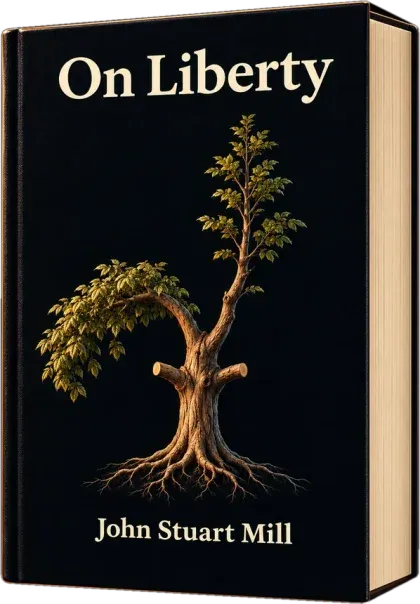
John Stuart Mill · 1859
On Liberty
On his walks with his father, John Stuart Mill learns to give an account of what he knows. James Mill means the boy to carry on his work. At fourteen, in the south of France, John begins to discover how differently the affairs of the world may look from the other side of the Channel. Then, at a dinner in England, he meets Mrs. Taylor, whose judgment he will come to prize above any other. Even among friends, their attachment will scarcely bear mention without giving offence. There are liberties an Englishman enjoys by law for which he must still answer to his neighbours. Who gave the neighbours their authority?
- Reading time
- About 3 h 15 min
- With the voice
- 5 h 4 min
- Length
- 50,667 words · 10 chapters
- Level
- C2 CEFR
Read the opening · Part 1, Chapter 1 · 5 min
“John Stuart Mill was born on 20th May 1806.”
All of Part 1, Chapter 1, the way the Lightkeeper app reads it: one line of words past an amber letter, with the voice. Switch to Page to see the whole paragraph.
End of Part 1, Chapter 1
The rest of the book waits in the app.
You caught 0 gems. The rest of the book waits in the app.
Text: John Stuart Mill. Tap the ribbon to pause; tap while a line shimmers to catch it.
Who’s who
On Liberty characters
-
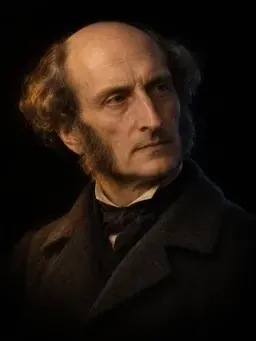
John Stuart Mill
An English writer and India House official, Mill asks how much authority a society may rightly exercise over a single life. He wants even the person who stands alone to have a hearing.
First named in Part 1, Chapter 1
-

Mrs. Taylor
Mill’s intellectual companion and later his wife, she asks what political economy can tell working people about their future. She helps him conceive Liberty and brings a close understanding of the restrictions women face.
First named in Part 1, Chapter 2
-
James Mill
John’s father turns their walks into occasions for teaching and examination. He means to equip his son to carry his own intellectual work forward.
First named in Part 1, Chapter 2
-
W. L. Courtney
In his introductory commentary, Courtney sets Mill’s devotion to individual liberty beside the long history of communal authority. He asks what society itself stands to gain when its members are free to differ.
First named in Part 1, Chapter 3
-
the Secretary
Speaking for the Alliance that seeks to prohibit the sale of fermented drinks, he maintains that the trade infringes his rights as a citizen. His claim gives Mill a precise test of how far one neighbour’s authority over another might extend.
First named in Part 2, Chapter 4
In the app you can talk to 5 of the characters. They answer from the page you’re on, so the story ahead stays yours to find. How it works
What happens
On Liberty summary
Spoilers below.
The Father’s Walk
On the walks James Mill took with his son, a boy’s lesson had to bear the trial of being told. What had John understood, and what account could he give of it to a man who meant him to carry on his work? At fourteen he went to the south of France with the family of General Sir Samuel Bentham. He brought home an interest in foreign politics which never left him. There was something to be learnt merely by crossing the Channel. An opinion which seemed to have the whole weight of mankind behind it in England might have very little company in France.
He was already publishing essays when he entered India House as a junior clerk. In time he rose to the head of the Examiners’ Office. There were the affairs of India to attend to by day, and questions of logic and political economy to take up when the office released him. A reader looking over the titles of his books might have supposed that the great events of such a life could be followed closely enough in a catalogue. He would have missed a dinner given by Mr. Taylor in 1831.
Inside the book
10 chapters
- Part 1, Chapter 1
- Part 1, Chapter 2 Mill called his wife's wisdom all but unrivalled. How much of his essay did he owe to her?
- Part 1, Chapter 3 What audience could Mill find for an eighteenth-century defence of liberty in the world of 1859?
- Part 2, Chapter 1 Liberty once meant protection from rulers. What claim can society itself make on the individual?
- Chapter 2 (1) What becomes of a free press when the demand to silence an opinion comes from the public itself?
- Chapter 2 (2) If we admit we can be wrong, how sure must we be before we deny an opinion a hearing?
- Chapter 2 (3) What if the missing part of a truth we hold dear belongs to the very people who dispute it?
- Part 2, Chapter 3 The same words appear in print and reach a crowd at a corn-dealer's door. What changes at the doorstep?
- Part 2, Chapter 4 Where does a person's freedom to live as they please meet the debt they owe to those who protect them?
- Part 2, Chapter 5 A neighbour makes a choice that affects only his own life. How far may others go in objecting?
Lines worth keeping
On Liberty quotes
Over himself, over his own body and mind, the individual is sovereign.
If all mankind minus one, were of one opinion, and only one person were of the contrary opinion, mankind would be no more justified in silencing that one person, than he, if he had the power, would be justified in silencing mankind.
He who knows only his own side of the case, knows little of that.
His youth was sacrificed to an idea; he was designed by his father to carry on his work; the individuality of the boy was unimportant.
This tone consisted chiefly in making the proper distinction between the laws of the production of wealth, which are real laws of Nature, dependent on the properties of objects, and the modes of its distribution, which, subject to certain conditions, depend on human will. … I had indeed partially learnt this view of things from the thoughts awakened in me by the speculations of St. Simonians; but it was made a living principle, pervading and animating the book, by my wife’s promptings.”
“The chapter which has had a greater influence on opinion than all the rest, that on the ‘Probable Future of the Labouring Classes,’ is entirely due to her. In the first draft of the book that chapter did not exist. She pointed out the need of such a chapter, and the extreme imperfection of the book without it; she was the cause of my writing it.”
ThemesThe tyranny of public opinionDissent and the pursuit of truthIndividuality in everyday lifeHarm and the limits of authorityFreedom through self-governmentLove and intellectual partnership
Questions
Before you start
How long does it take to read On Liberty?
On Liberty is 50,667 words. At an average adult pace for fiction, about 260 words a minute (Brysbaert, 2019), that’s about 3 h 15 min. With the voice at normal speed it takes 5 h 4 min, and about 3 h 23 min at 1.5×.
Is there a On Liberty audiobook with the text?
Yes. In Lightkeeper the voice reads while the words move past one amber letter, so your eyes and ears stay on the same word. Speed it up or slow it down and the voice keeps pace. The opening of Part 1, Chapter 1 is on this page to try.
What reading level is On Liberty?
C2 on the CEFR scale, which runs from A1, the easiest, to C2. The language is demanding; reading along with the voice helps keep the thread.
Read all of On Liberty in Lightkeeper
With the voice, the gems to find and the characters to talk to. On iPhone and Android.
More from the shelf