
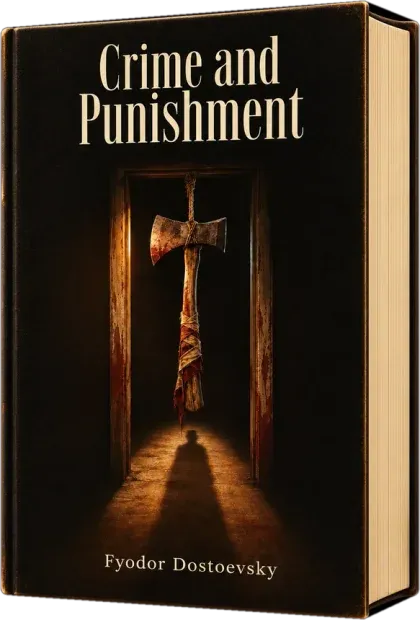
Fyodor Dostoevsky · 1866
Crime and Punishment
In the suffocating summer streets of Petersburg, a young man walks towards a pawnbroker’s door, rehearsing a visit he can scarcely bear to imagine. Rodion Raskolnikov has abandoned his studies, withdrawn from his friends, and shut himself into a garret scarcely larger than a cupboard. Around him, poverty exacts its price: a daughter sells herself to feed hungry children; his own sister prepares to marry a man who expects gratitude in place of love. Raskolnikov believes there may be a way to break the bargain—a terrible act that a sufficiently extraordinary man might permit himself. But who decides where necessity ends and evil begins? And what happens when the mind that invents the justification must live with the deed?
- Reading time
- About 13 h 5 min
- With the voice
- 19 h 33 min
- Length
- 204,026 words · 41 chapters
- Level
- B1 CEFR
Read the opening · Part 1, Chapter 1 · 7 min
“On an exceptionally hot evening early in July a young man came out of the garret in which he lodged in S—— Place and…”
The first minutes of Part 1, Chapter 1, the way the Lightkeeper app reads it: one line of words past an amber letter, with the voice. Switch to Page to see the whole paragraph.
End of the opening
Part 1, Chapter 1 goes on in the app.
You caught 0 gems. The rest of the book waits in the app.
Text: Fyodor Dostoevsky. Tap the ribbon to pause; tap while a line shimmers to catch it.
Who’s who
Crime and Punishment characters
-

Rodion Romanovitch Raskolnikov
An impoverished former student living in a Petersburg garret, divided between fierce compassion and intellectual pride. He longs to discover whether an extraordinary person may cross the moral boundaries that govern everyone else.
First named in Part 1, Chapter 1
-
Sofya Semyonovna Marmeladov (Sonia)
Marmeladov’s daughter, driven into prostitution to support her family. Sustained by religious faith, she seeks to protect those she loves without surrendering her capacity for tenderness.
First named in Part 1, Chapter 2
-

Avdotya Romanovna Raskolnikov (Dounia)
Raskolnikov’s courageous, proud sister, whose work and marriage prospects carry her family’s hopes. She wants to help her brother while preserving her dignity and freedom of judgment.
First named in Part 1, Chapter 3
-

Razumihin
Raskolnikov’s resourceful former university companion, generous even when his friendship meets with hostility. He seeks useful work, loyal companionship, and practical ways to help the people he loves.
First named in Part 1, Chapter 4
-
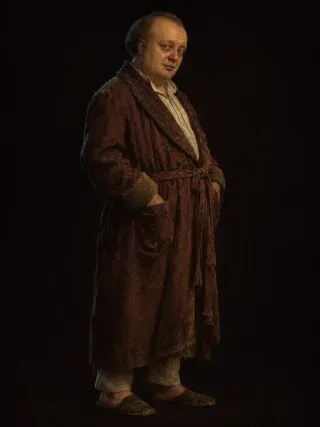
Porfiry Petrovitch
The investigator concerned with the pawnbroker’s murder, whose informal manner conceals close attention to human motives. He pursues truth through conversation, uncertainty, and the pressure a troubled conscience puts upon itself.
First named in Part 2, Chapter 4
-
Arkady Ivanovitch Svidrigaïlov
Dounia’s former employer, a wealthy man whose unsettling candour accompanies persistent manipulation. He pursues pleasure and Dounia’s affection while struggling with boredom and disturbing memories.
First named in Part 1, Chapter 3
-
Pyotr Petrovitch Luzhin
Dounia’s prosperous fiancé, who regards marriage as an opportunity to secure admiration and obedience. He wants a poor wife whose gratitude will confirm his importance.
First named in Part 1, Chapter 3
-
Semyon Zaharovitch Marmeladov
A government clerk ruined by drinking, painfully conscious of the suffering he brings upon his family. He longs for forgiveness even as he repeats the conduct that makes him need it.
First named in Part 1, Chapter 2
In the app you can talk to 14 of the characters. They answer from the page you’re on, so the story ahead stays yours to find. How it works
What happens
Crime and Punishment summary
Spoilers below.
The Stifling City
In the heat of a Petersburg summer, Rodion Romanovitch Raskolnikov crept down from his garret, anxious to escape his landlady’s eye. He owed her money; he owed everyone explanations. Once a student, he now lay for hours beneath the low ceiling, nursing an idea that alternately exalted and disgusted him. In the streets, where dust rose above the stones and drunken voices poured from tavern doors, the idea seemed to acquire a will of its own.
He went to Alyona Ivanovna, the old pawnbroker, with his father’s silver watch. While she reckoned her deductions, he observed her keys, the arrangement of the rooms, the movements of her suspicious eyes. He asked after her sister Lizaveta. He had come to rehearse something; yet, once outside, he recoiled from himself as though he had touched corruption.
In a tavern he met Marmeladov, a ruined clerk who spoke with the dreadful eloquence of a man determined to conceal nothing. At home his consumptive wife, Katerina Ivanovna, struggled with three hungry children. His daughter Sonia had gone into prostitution to feed them. He had regained employment, restored their hopes, and then stolen the wages and drunk them away. Even his present glass had been purchased with Sonia’s last money. He wept over his degradation and dreamed of a forgiveness large enough to receive the utterly disgraced.
Raskolnikov took him home. Before the sick woman’s anger and the children’s frightened faces, he secretly left a little money. Afterwards he resented his own generosity. Why must Sonia bear the burden? Why did everyone accept such sacrifices?
A letter from his mother brought the question nearer. His sister Dounia, having escaped the pursuit and slanders of her former employer Svidrigaïlov, had agreed to marry Pyotr Petrovitch Luzhin. The prosperous gentleman preferred a poor wife, one who would remember her obligation to him. Their mother hoped this marriage would restore Rodion’s prospects. Raskolnikov understood what lay beneath those hopeful sentences: Dounia was offering herself for his sake.
He wandered until exhaustion overcame him. In sleep he became a child again, watching drunken men beat an overloaded mare. He rushed to the dying creature, embraced its bloody head, and awoke in horror. No—he could never commit the murder he had imagined. For a little while he breathed freely.
Then, crossing the Hay Market, he overheard that Lizaveta would be away the following evening. The old woman would be alone. He returned to his room with the sensation that someone had taken him by the hand and was leading him.
Inside the book
41 chapters
- Translator’s Preface
- Part 1, Chapter 1 A young man slips out of his garret, troubled less by his debts than by the prospect of meeting anyone.
- Part 1, Chapter 2 After weeks of solitude, why does a filthy tavern suddenly feel like a refuge?
- Part 1, Chapter 3 Raskolnikov wakes with hatred for his cramped room—and a strange attachment to its disorder.
- Part 1, Chapter 4 His mother's letter has settled one thing for Raskolnikov: his sister's marriage must not happen.
- Part 1, Chapter 5 A simple plan to visit a friend forces Raskolnikov to confront the meaning of a single word: after.
- Part 1, Chapter 6 An ordinary errand takes on an ominous significance in Raskolnikov's mind.
- Part 1, Chapter 7 At the pawnbroker's half-open door, Raskolnikov struggles to keep his voice from betraying him.
- Part 2, Chapter 1 He wakes with a violent shiver, an unlocked door, and the sudden return of everything he remembers.
- Part 2, Chapter 2 With stolen objects filling his pockets, Raskolnikov needs somewhere to hide the traces.
- Part 2, Chapter 3 As the fever lifts, Raskolnikov struggles to distinguish his visitors from the figures of his delirium.
- Part 2, Chapter 4 Raskolnikov insists he is well, but the doctor at the foot of his sofa keeps watching.
- Part 2, Chapter 5 A prosperous stranger surveys Raskolnikov's room with an astonishment that promises little warmth.
- Part 2, Chapter 6 Suddenly calm and intent on a purpose, Raskolnikov slips out into the stifling evening.
- Part 2, Chapter 7 A crowd surrounds a stopped carriage, and beneath its wheels lies a badly injured man.
- Part 3, Chapter 1 His mother and sister have finally reached him—why can Raskolnikov only beg them to leave?
- Part 3, Chapter 2 Razumihin wakes ashamed of yesterday's jealousy and of a hope he scarcely dares acknowledge.
- Part 3, Chapter 3 Raskolnikov is washed, dressed, and pronounced well, yet his family's arrival sharpens his distress.
- Part 3, Chapter 4 Sonia appears in the crowded doorway, bringing Raskolnikov's recent words uncomfortably to life.
- Part 3, Chapter 5 Raskolnikov enters Porfiry's room laughing, while Razumihin's fury makes the laughter harder to stop.
- Part 3, Chapter 6 On the way to his family, Raskolnikov weighs every word of an encounter Razumihin refuses to distrust.
- Part 4, Chapter 1 An unexpected visitor asks for help in approaching Dounia, and Raskolnikov questions his own senses.
- Part 4, Chapter 2 Raskolnikov urges Razumihin to help protect Dounia from a man whose intentions remain obscure.
- Part 4, Chapter 3 Luzhin cannot understand how two penniless women have slipped beyond his control.
- Part 4, Chapter 4 Raskolnikov finds Sonia's door in a dark gallery, and his arrival leaves her shaken.
- Part 4, Chapter 5 Summoned at last to Porfiry, Raskolnikov finds the freedom to walk away strangely unsettling.
- Part 4, Chapter 6 Porfiry's orders cannot keep a pale young prisoner from forcing his way into the room.
- Part 5, Chapter 1 Morning brings Luzhin no escape from his wounded vanity—or his companion's knowing smile.
- Part 5, Chapter 2 With money running short, Katerina Ivanovna stakes her dignity on a funeral dinner.
- Part 5, Chapter 3 Katerina Ivanovna appeals to Luzhin for protection, but he has come to speak to Sonia.
- Part 5, Chapter 4 At Sonia's door, Raskolnikov falters before a disclosure he feels unable to delay.
- Part 5, Chapter 5 Lebeziatnikov arrives with an alarming account of Katerina Ivanovna and no clear idea how to help.
- Part 6, Chapter 1 Fear gives way to apathy as Raskolnikov loses his grasp on the order and meaning of events.
- Part 6, Chapter 2 Porfiry talks of cigarettes and an unannounced visit, while Raskolnikov waits for his real purpose.
- Part 6, Chapter 3 Raskolnikov hurries to Svidrigaïlov, unsure what he wants from the man who holds power over him.
- Part 6, Chapter 4 Svidrigaïlov describes the bargain behind his marriage, presenting brutal frankness as a kind of honesty.
- Part 6, Chapter 5 Convinced Dounia is still in danger, Raskolnikov refuses to let Svidrigaïlov out of his sight.
- Part 6, Chapter 6 Svidrigaïlov passes the evening among tavern companions, drawn into their shabby amusements and quarrels.
- Part 6, Chapter 7 Exhausted and rain-soaked, Raskolnikov reaches his mother's door with a decision he can no longer evade.
- Part 6, Chapter 8 As darkness gathers, Sonia waits for Raskolnikov, afraid of what may be keeping him away.
- Epilogue, Chapter 1 In a Siberian prison, Raskolnikov is nine months into his sentence; his crime has been fully accounted for.
- Epilogue, Chapter 2 Prison hardships leave Raskolnikov unmoved, but his wounded pride offers him no rest.
Lines worth keeping
Crime and Punishment quotes
It would be interesting to know what it is men are most afraid of. Taking a new step, uttering a new word is what they fear most.
“I did not bow down to you, I bowed down to all the suffering of humanity,” he said wildly and walked away to the window.
I wanted to find out then and quickly whether I was a louse like everybody else or a man. Whether I can step over barriers or not, whether I dare stoop to pick up or not, whether I am a trembling creature or whether I have the right …”
In the words of a Russian critic, who seeks to explain the feeling inspired by Dostoevsky: “He was one of ourselves, a man of our blood and our bone, but one who has suffered and has seen so much more deeply than we have his insight impresses us as wisdom … that wisdom of the heart which we seek that we may learn from it how to live. All his other gifts came to him from nature, this he won for himself and through it he became great.”
Now, a month later, he had begun to look upon them differently, and, in spite of the monologues in which he jeered at his own impotence and indecision, he had involuntarily come to regard this “hideous” dream as an exploit to be attempted, although he still did not realise this himself. He was positively going now for a “rehearsal” of his project, and at every step his excitement grew more and more violent.
Honoured sir, honoured sir, you know every man ought to have at least one place where people feel for him!
ThemesPride and moral transgressionConscience and self-deceptionPoverty and exploitationSacrifice and human solidarityFaith, suffering, and renewalIsolation and the need for love
Questions
Before you start
How long does it take to read Crime and Punishment?
Crime and Punishment is 204,026 words. At an average adult pace for fiction, about 260 words a minute (Brysbaert, 2019), that’s about 13 h 5 min. With the voice at normal speed it takes 19 h 33 min, and about 13 h 2 min at 1.5×.
Is there a Crime and Punishment audiobook with the text?
Yes. In Lightkeeper the voice reads while the words move past one amber letter, so your eyes and ears stay on the same word. Speed it up or slow it down and the voice keeps pace. The opening of Part 1, Chapter 1 is on this page to try.
What reading level is Crime and Punishment?
B1 on the CEFR scale, which runs from A1, the easiest, to C2.
Read all of Crime and Punishment in Lightkeeper
With the voice, the gems to find and the characters to talk to. On iPhone and Android.
More from the shelf
More by Fyodor Dostoevsky and others
-
 The Brothers Karamazov Fyodor Dostoevsky 33 h 10 min · B1
-
 Notes from Underground Fyodor Dostoevsky 4 h 5 min · B2
-
 Oliver Twist Charles Dickens 15 h 10 min · B2
-
 The Awakening Kate Chopin 4 h 40 min · B1
-
 The Lady with the Dog and Other Stories Anton Chekhov 3 h 15 min · B2
-
 Great Expectations Charles Dickens 16 h 40 min · B2