
Fyodor Dostoevsky · Crime and Punishment
Crime and Punishment Part 3, Chapter 5 summary
- Reading time
- About 27 min
- With the voice
- 42 min
- Length
- 7,012 words
- In the book
- 19 of 41 chapters
Summary
What happens in Part 3, Chapter 5
Spoilers for this chapter only.
Raskolnikov and Razumihin visit Porfiry Petrovitch and find Zametov already there. Raskolnikov asks how to establish his ownership of a ring and watch pledged with the murdered woman, and Porfiry reveals that he has been expecting him. Remarks about Raskolnikov’s illness, movements, and money make him increasingly angry and suspicious. Porfiry introduces Raskolnikov’s published article, prompting him to explain his theory that extraordinary people may authorize themselves to break laws and shed blood when their ideas require it. Razumihin objects to this sanction by conscience, while Porfiry asks whether Raskolnikov has imagined himself extraordinary and capable of robbery or murder. As they leave, Porfiry invites Raskolnikov to return the next morning and questions him about painters in the building; Razumihin points out the conflicting dates, Porfiry claims confusion, and the visitors depart in gloomy silence.
Listen and read · Part 3, Chapter 5 · 1.5 min
“Raskolnikov was already entering the room.”
The opening of Part 3, Chapter 5, the way the Lightkeeper app reads it: one line of words past an amber letter, with the voice. Switch to Page to see the whole paragraph.
End of the opening
Part 3, Chapter 5 goes on in the app.
The rest of the book waits in the app.
Text: Fyodor Dostoevsky. Tap the ribbon to pause.
Who’s who
Characters in Part 3, Chapter 5
In the order they are named in this chapter.
-

Razumihin
Raskolnikov’s resourceful former university companion, generous even when his friendship meets with hostility. He seeks useful work, loyal companionship, and practical ways to help the people he loves.
-

Rodion Romanovitch Raskolnikov
An impoverished former student living in a Petersburg garret, divided between fierce compassion and intellectual pride. He longs to discover whether an extraordinary person may cross the moral boundaries that govern everyone else.
-
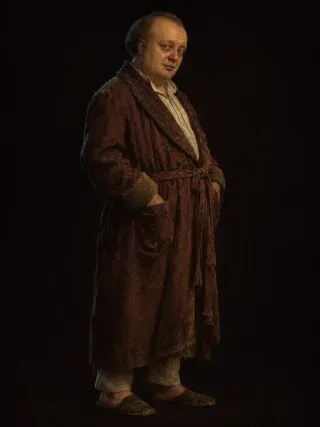
Porfiry Petrovitch
The investigator concerned with the pawnbroker’s murder, whose informal manner conceals close attention to human motives. He pursues truth through conversation, uncertainty, and the pressure a troubled conscience puts upon itself.
Lines worth keeping
Crime and Punishment Part 3, Chapter 5 quotes
You can’t skip over nature by logic. Logic presupposes three possibilities, but there are millions!
I simply hinted that an ‘extraordinary’ man has the right … that is not an official right, but an inner right to decide in his own conscience to overstep … certain obstacles, and only in case it is essential for the practical fulfilment of his idea (sometimes, perhaps, of benefit to the whole of humanity).
You are right, of course, in saying that it’s not new, that it’s like what we’ve read and heard a thousand times already; but what is really original in all this, and is exclusively your own, to my horror, is that you sanction bloodshed in the name of conscience, and, excuse my saying so, with such fanaticism. … That, I take it, is the point of your article. But that sanction of bloodshed by conscience is to my mind … more terrible than the official, legal sanction of bloodshed.
Pain and suffering are always inevitable for a large intelligence and a deep heart. The really great men must, I think, have great sadness on earth,” he added dreamily, not in the tone of the conversation.
Check yourself
Part 3, Chapter 5 questions
-
What business brings Raskolnikov to Porfiry?
- He wants to report that someone has stolen his father’s silver watch.
- He wants to collect the money owed for his recently published article.
- He wants to claim his pledged belongings until he can afford to redeem them.
- He wants to recover the money he gave a widow for her husband’s funeral.
Answer
C. He wants to claim his pledged belongings until he can afford to redeem them.
-
What does Razumihin find especially disturbing in Raskolnikov’s theory?
- It demands that all exceptional people commit crimes to prove themselves.
- It explains every crime as a necessary consequence of social conditions.
- It allows a person’s conscience to authorize bloodshed for an idea.
- It denies society any right to punish people who break its laws.
Answer
C. It allows a person’s conscience to authorize bloodshed for an idea.
-
Why does Razumihin challenge Porfiry’s question about the painters?
- The painters had already confirmed that Raskolnikov never entered their flat.
- The painters left before seven, earlier than the time Porfiry mentioned.
- The painters worked on the murder day, three days after Raskolnikov’s earlier visit.
- The painters worked downstairs, where Raskolnikov had no reason to go.
Answer
C. The painters worked on the murder day, three days after Raskolnikov’s earlier visit.
Read all of Part 3, Chapter 5 with the voice
The whole chapter and the rest of Crime and Punishment wait in the Lightkeeper app, on iPhone and Android.