

Gaston Leroux · 1910
The Phantom of the Opera
The ghost of the Paris Opera keeps a private box. Madame Giry takes him his programme, holds herself ready in case he should want a footstool, and sees no reason why a gentleman who tips so handsomely should have to show his face. The new managers take a different view. They mean to sell Box Five. Meanwhile, a young singer named Christine Daaé has found a voice that brings the house to its feet, and Raoul de Chagny, who knew her when she was a fiddler’s daughter, would give a great deal to know who taught her. Outside her dressing-room he hears a man demand her love. Christine comes out alone. Raoul has watched the only door. Who, then, is still in the room?
- Reading time
- About 5 h 15 min
- With the voice
- 7 h 52 min
- Length
- 82,233 words · 28 chapters
- Level
- B1 CEFR
Read the opening · Prologue · 9 min
“In which the author of this singular work informs the reader how he acquired the certainty that the Opera Ghost really…”
All of Prologue, the way the Lightkeeper app reads it: one line of words past an amber letter, with the voice. Switch to Page to see the whole paragraph.
End of Prologue
The rest of the book waits in the app.
You caught 0 gems. The rest of the book waits in the app.
Text: Gaston Leroux. Tap the ribbon to pause; tap while a line shimmers to catch it.
Who’s who
The Phantom of the Opera characters
-

Christine Daaé
A fiddler’s daughter and a singer at the Paris Opera, Christine hears in her unseen teacher’s voice the fulfilment of a promise her father made. Her love for Raoul makes it urgent to discover what that teacher expects in return.
First named in Prologue
-

Erik
The man known as the Opera ghost can make his voice come from an empty chair and teach a singer to move an entire house. He longs for Christine to look upon him with love.
First named in Chapter 9
-

Raoul de Chagny
A young viscount about to sail on a Polar expedition, Raoul has loved Christine since they were children by the sea. He wants her confidence as keenly as he wants to protect her, and jealousy sometimes makes him a poor listener.
First named in Chapter 5
-

the Persian
A familiar figure to the Opera’s subscribers, the Persian knows Erik from an earlier life at the court of the Shah. Old affection and an intimate knowledge of Erik’s cruelty draw him into Christine’s danger.
First named in Prologue
-
Count Philippe de Chagny
Raoul’s elder brother accompanies him backstage and keeps a fond eye on his affairs. News that the young viscount means to marry the singer turns his indulgence into alarm.
-
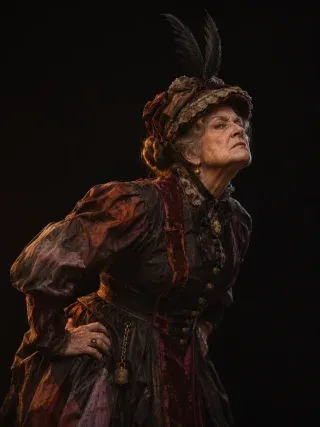
Madame Giry
The keeper of Box Five attends to her invisible subscriber with professional courtesy. He tips her well and has foretold a magnificent future for her daughter Meg.
First named in Prologue
-
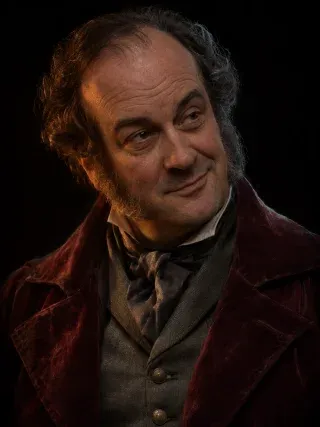
Firmin Richard
One of the incoming Opera managers, Richard intends to choose his own singers, appoint his own staff and sell every seat in the house. A demand written in red ink strikes him as an excellent reason to do the opposite.
First named in Chapter 3
-
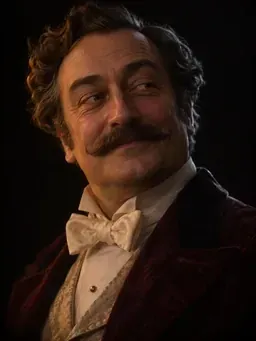
Armand Moncharmin
Richard’s partner in the management is quite prepared to laugh at the ghost until money begins to disappear. He sets himself to watch every hand through which the next payment passes.
First named in Prologue
In the app you can talk to 10 of the characters. They answer from the page you’re on, so the story ahead stays yours to find. How it works
What happens
The Phantom of the Opera summary
Spoilers below.
The Gentleman in Box Five
When the workmen came upon a skeleton beneath the Paris Opera, there were still people alive who could have told them whose bones they had disturbed. One had handled the gentleman’s correspondence. Another had put money in his pocket. A third had heard him weep. Of these witnesses the police had made very little use, particularly of the last, a Persian whom the magistrate considered an imaginative fellow. I was fortunate enough to find him. He put into my hands some letters in a young woman’s writing, and it is owing in great part to him that I can take the reader back to the evening when Christine Daaé first sang Margarita as Paris remembers her.
It was a gala night. Two managers were retiring, two were coming in, and in Sorelli’s dressing-room a little knot of ballet-girls stood pressed together in their gauze skirts. They had seen a gentleman in evening clothes with a death’s head above his shirtfront. Little Meg Giry could have given them his address. Her mother looked after Box Five, where he received his programme as regularly as any subscriber. Then somebody brought word that Joseph Buquet, the scene-shifter who had so often described that very face, was hanging in the third cellar. By the time anybody thought to examine the rope, it had disappeared.
Above all this fright and whispering rose a voice of such sweetness that the young Vicomte Raoul de Chagny could scarcely believe he knew the singer. Yet he had once gone into the sea after her scarf, and what was an evening’s triumph beside such a claim as that? He hurried to her dressing-room. Christine laughed when he reminded her of the scarf. Presently she sent everybody away. From the passage Raoul heard a man ask for her love, and heard Christine answer that it was for him alone she sang. She came out. Raoul went in. There was a mirror, there were chairs, there was the smell of a crowded room newly emptied. He looked everywhere for the man.
Inside the book
28 chapters
- Prologue
- Chapter 1 The ballet girls burst into Sorelli’s dressing-room, but what has little Jammes so quick to lock the door?
- Chapter 2 The count can talk only of Christine’s triumph, but the dancers have come upstairs with grimmer news.
- Chapter 3 Sorelli has her farewell speech ready, if she can make herself heard above the whispers.
- Chapter 4 The new managers have all but forgotten the ghost, and Box Five is about to claim their attention.
- Chapter 5 Paris wants to hear Christine sing again, so why does she beg the count to stop putting in a good word?
- Chapter 6 From the stalls of the nearly empty Opera, the managers can barely make out Box Five in the gloom.
- Chapter 7 Faust is on the bill tonight, and the ghost has taken the liberty of casting Margarita.
- Chapter 8 After a fortnight without word from Christine, Raoul takes his questions to two badly shaken managers.
- Chapter 9 A mud-stained envelope reaches Raoul by chance, with just enough inside to make him hope again.
- Chapter 10 Christine is home again, and all is well until Mamma Valérius gives the credit to her music teacher.
- Chapter 11 Raoul may sail in three weeks, and the thought of parting forever puts a strange light in Christine’s eyes.
- Chapter 12 High above Paris, Christine draws Raoul close, sure that under Apollo’s lyre they can speak freely.
- Chapter 13 Fleeing the eyes on the roof, Raoul and Christine meet a man who insists they are going the wrong way.
- Chapter 14 Backstage, everyone has a theory about Christine’s disappearance, and the managers’ door is locked.
- Chapter 15 Raoul presses his ear to the stage boards, desperate to hear Christine answer from below.
- Chapter 16 The ghost’s first twenty thousand francs passed through Mme. Giry’s hands, but where did they go next?
- Chapter 17 Mme. Giry is to repeat the payment exactly, and this time Moncharmin means to watch Richard’s pocket.
- Chapter 18 The commissary asks the managers for Christine and finds he must first tell them she is missing.
- Chapter 19 Raoul is racing to Christine’s rescue when the Persian tells him his best hope is to stay where he is.
- Chapter 20 A wall swings shut behind Raoul, and the Persian’s lantern picks out a wooden passage in the dark.
- Chapter 21 The Persian recalls the day he rowed toward Erik’s hidden door and heard singing rise from the water.
- Chapter 22 Christine is close enough to hear through the wall of mirrors, if only Raoul dares to call her name.
- Chapter 23 Through the wall, Raoul hears Christine try to laugh off Erik’s questions about his missing keys.
- Chapter 24 The Persian has seen this room of mirrors before, but the iron tree was once an ordinary column.
- Chapter 25 At eleven the Opera will be full, and only the men below know what Christine’s refusal could cost.
- Chapter 26 The Persian’s manuscript ends, but in his room overlooking the Tuileries he still has a story to tell.
- Epilogue Paris had its own story about Christine and the two Chagnys, but where did the missing lovers go?
Lines worth keeping
The Phantom of the Opera quotes
The Opera ghost really existed. He was not, as was long believed, a creature of the imagination of the artists, the superstition of the managers, or a product of the absurd and impressionable brains of the young ladies of the ballet, their mothers, the box-keepers, the cloakroom attendants or the concierge. Yes, he existed in flesh and blood, although he assumed the complete appearance of a real phantom; that is to say, of a spectral shade.
… I tore off my mask so as not to lose one of her tears … and she did not run away! … And she did not die! … She remained alive, weeping over me, with me.
He had a heart that could have held the empire of the world; and, in the end, he had to content himself with a cellar.
It will be remembered that, later, when digging in the substructure of the Opera, before burying the phonographic records of the artist’s voice, the workmen laid bare a corpse. Well, I was at once able to prove that this corpse was that of the Opera ghost.
They were there, side by side, leaning forward simultaneously in one movement of entreaty and fear, communicating their terror to one another, taking a keen pleasure in feeling their blood freeze in their veins.
“Well, that’s the ghost’s box. No one has had it for over a month, except the ghost, and orders have been given at the box-office that it must never be sold.”
ThemesLove and possessionThe longing to be seenGrief and the power of musicIllusion and beliefCompassion freely given
Questions
Before you start
How long does it take to read The Phantom of the Opera?
The Phantom of the Opera is 82,233 words. At an average adult pace for fiction, about 260 words a minute (Brysbaert, 2019), that’s about 5 h 15 min. With the voice at normal speed it takes 7 h 52 min, and about 5 h 15 min at 1.5×.
Is there a The Phantom of the Opera audiobook with the text?
Yes. In Lightkeeper the voice reads while the words move past one amber letter, so your eyes and ears stay on the same word. Speed it up or slow it down and the voice keeps pace. The opening of Prologue is on this page to try.
What reading level is The Phantom of the Opera?
B1 on the CEFR scale, which runs from A1, the easiest, to C2.
Read all of The Phantom of the Opera in Lightkeeper
With the voice, the gems to find and the characters to talk to. On iPhone and Android.
More from the shelf
You might read next
-
 The Vampire John William Polidori 1 h · C1
-
 Jane Eyre Charlotte Brontë 18 h 15 min · B2
-
 The Turn of the Screw Henry James 3 h 55 min · B2
-
 The Tell-Tale Heart and Other Tales of Terror Edgar Allan Poe 2 h 55 min · C1
-
 Emma Jane Austen 15 h · B2
-
 The Strange Case of Dr. Jekyll and Mr. Hyde Robert Louis Stevenson 2 h 20 min · B2