Jonathan Swift · 1726
Gulliver’s Travels
Shipwrecked surgeon Lemuel Gulliver wakes upon an unfamiliar shore to find his limbs bound fast—and an army of men scarcely six inches high advancing across his breast. In Lilliput, he is a wonder, a prisoner, and a weapon powerful enough to alter the fortunes of an empire. Yet the smallest courtiers possess ambitions equal to any in Europe, and royal favour comes attended by jealousies, ceremonies, and dangerous obligations. To recover his liberty, Gulliver must learn the manners of a world whose absurdities look increasingly familiar. What becomes of a reasonable man when his freedom depends upon the vanity of princes—and his greatest service may prove his greatest crime?
- Reading time
- About 6 h 40 min
- With the voice
- 9 h 21 min
- Length
- 104,083 words · 39 chapters
- Level
- C1 CEFR
Read the opening · Part 1, Chapter 1 · 8 min
“The author gives some account of himself and family.”
The first minutes of Part 1, Chapter 1, the way the Lightkeeper app reads it: one line of words past an amber letter, with the voice. Switch to Page to see the whole paragraph.
End of the opening
Part 1, Chapter 1 goes on in the app.
You caught 0 gems. The rest of the book waits in the app.
Text: Jonathan Swift. Tap the ribbon to pause; tap while a line shimmers to catch it.
Who’s who
Gulliver’s Travels characters
-

Lemuel Gulliver
An English surgeon and restless voyager who approaches extraordinary countries with practical curiosity and confidence in his own truthfulness. He seeks livelihood, knowledge, and a secure place in societies that repeatedly unsettle his understanding of mankind.
-

Mary Burton
Gulliver’s wife, who maintains their family life through his prolonged absences. She hopes his returns will bring an end to his dangerous voyages.
First named in Part 1, Chapter 1
-
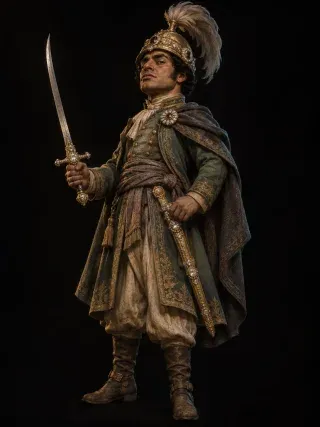
The Emperor of Lilliput
The diminutive sovereign of a ceremonious and ambitious court. He sees Gulliver’s enormous strength as both a danger to manage and an instrument of imperial power.
-
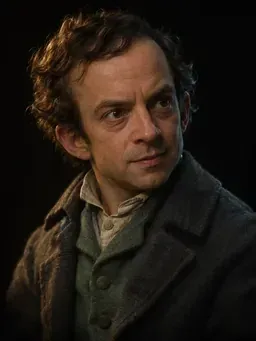
Reldresal
Lilliput’s principal secretary for private affairs and a friendly guide to its political divisions. He seeks Gulliver’s assistance against the dangers facing the empire.
First named in Part 1, Chapter 3
-
Flimnap
The treasurer of Lilliput and an accomplished rope-dancer. Jealous of his position and attentive to the cost of maintaining Gulliver, he views the enormous visitor with growing suspicion.
First named in Part 1, Chapter 3
-
Skyresh Bolgolam
Lilliput’s sour-tempered admiral and a determined opponent of Gulliver’s liberty. He uses his influence at court to impose restrictions upon the man-mountain.
First named in Part 1, Chapter 3
-
Glumdalclitch
The farmer’s young daughter in Brobdingnag, who becomes Gulliver’s devoted nurse and language teacher. She wants to protect her tiny charge from exploitation and the countless dangers of her enormous world.
First named in Part 2, Chapter 2
-
The King of Brobdingnag
An inquisitive monarch who questions Gulliver closely about European government and society. He values practical wisdom, justice, and the welfare of his subjects.
In the app you can talk to 10 of the characters. They answer from the page you’re on, so the story ahead stays yours to find. How it works
What happens
Gulliver’s Travels summary
Spoilers below.
The Man-Mountain
Lemuel Gulliver had learned surgery, married Mary Burton, and tried the sober business of earning his bread ashore; but whenever his practice dwindled, the sea offered another livelihood. Thus he sailed in the Antelope, and thus, when that vessel struck a rock, he found himself swimming for life towards an unknown coast. He reached the grass, drank a little brandy, and slept with the profoundness of a man who had escaped death without knowing what awaited him.
At daylight he could not stir. His arms, legs, and hair were fastened to the earth; slender cords crossed his body. Something mounted his breast—a human creature less than six inches high, carrying a bow. When Gulliver struggled, arrows pricked him like a shower of needles. He lay still, considering that prudence might serve him better than strength.
The people fed him by the basketful, drugged his wine, and conveyed him upon a wheeled engine towards their capital. In a disused temple, chained by one leg, he received the Emperor of Lilliput. Here was majesty complete in every particular, reduced only in its dimensions. The court debated whether its prodigious captive should be maintained or destroyed. Gulliver improved his prospects by releasing unharmed six offenders delivered into his hands.
Teachers instructed him; officers searched his pockets, finding mysteries in a watch and terrors in a pistol. He surrendered his weapons, though his spectacles remained concealed. Before long he understood that advancement in Lilliput required peculiar accomplishments. Candidates for office danced upon a rope, while honours rewarded dexterity in creeping and leaping. The emperor marched soldiers beneath Gulliver’s legs; Gulliver provided a handkerchief stage for cavalry. His liberty, when it came, was burdened with articles drafted by the hostile admiral Skyresh Bolgolam.
Walking cautiously through Mildendo, he admired streets he could ruin with a careless foot. Reldresal, a friendly secretary, explained the greater dangers threatening the state. Parties disputed the proper height of heels. Lilliput and neighbouring Blefuscu had shed much blood over the end at which an egg ought to be broken. Gulliver declined their domestic quarrels but promised protection against invasion.
Wading across the channel, with spectacles shielding his eyes from arrows, he cut the cables of fifty enemy warships and towed them away. The emperor bestowed his highest honour upon him, then desired the conquest and enslavement of Blefuscu. Gulliver refused. His usefulness had discovered a boundary, and gratitude immediately began to cool.
A fire in the empress’s apartments completed his misfortune. Finding the buckets hopelessly small, he extinguished the flames with his urine. He had saved the palace by committing a capital offence. The empress would never forgive him; Flimnap, the treasurer, complained of his expense and entertained suspicions concerning his own wife. A secret visitor finally brought news of imperial mercy: Gulliver would be blinded, then starved by degrees.
He could have crushed his enemies, but remembered his oath. Instead he crossed to Blefuscu under permission already granted. There he recovered an overturned boat and fitted it for the sea. Refusing further dependence upon princes, he departed with provisions and miniature livestock. An English captain rescued him; the little cattle established what his word alone could scarcely prove. At home he embraced his family, earned money from his curiosities—and within two months sailed again.
Inside the book
39 chapters
- Introduction
- Preface Gulliver has a grievance with his publisher: whose words have found their way into his travels?
- Part 1
- Part 1, Chapter 1 A young surgeon studies navigation, certain that his future lies somewhere beyond England.
- Part 1, Chapter 2 From his chained doorstep, Gulliver surveys a country that looks almost too small to be real.
- Part 1, Chapter 3 Gulliver is winning Lilliput's trust, but how far will imperial favour carry him towards freedom?
- Part 1, Chapter 4 The gates of Mildendo are open to Gulliver, whose smallest careless step could wreck a house.
- Part 1, Chapter 5 Across a narrow channel, an enemy fleet waits—and Gulliver begins measuring the water.
- Part 1, Chapter 6 In Lilliput, even a cook's smallest task tests the limits of Gulliver's sight.
- Part 1, Chapter 7 A secret visitor arrives after dark, disturbing Gulliver's confidence in the court he serves.
- Part 1, Chapter 8 Off the coast of Blefuscu, Gulliver spots an overturned shape that the tide is bringing closer.
- Part 2
- Part 2, Chapter 1 Home holds Gulliver for barely two months before another voyage puts his restless nature to the test.
- Part 2, Chapter 2 In a world of giants, Gulliver depends on a nine-year-old girl for shelter, clothes, and words.
- Part 2, Chapter 3 Gulliver's master grows richer as his captive grows weaker—then a summons arrives from court.
- Part 2, Chapter 4 Beyond the giant king's palace lies a country Gulliver believes could overturn Europe's maps.
- Part 2, Chapter 5 The royal gardens promise Gulliver some freedom, but at his size, even an apple tree poses a threat.
- Part 2, Chapter 6 At the king's levee, Gulliver watches a razor twice the length of a scythe and sees an opportunity.
- Part 2, Chapter 7 Caught between truth and patriotism, Gulliver struggles to defend England before an inquisitive king.
- Part 2, Chapter 8 Cherished at court, Gulliver still longs for a place where he can walk without fearing every footstep.
- Part 3
- Part 3, Chapter 1 An old captain's friendly visits bring Gulliver an offer that could unsettle his brief return home.
- Part 3, Chapter 2 Among Laputa's strangely distracted inhabitants, servants carry bladders on sticks—but to what purpose?
- Part 3, Chapter 3 An island hangs in the air, and Gulliver wants to know what keeps it there.
- Part 3, Chapter 4 On an island devoted to mathematics and music, Gulliver struggles to find anyone he can talk to.
- Part 3, Chapter 5 Inside Lagado's academy, a soot-stained inventor has spent eight years seeking sunshine in cucumbers.
- Part 3, Chapter 6 In Lagado's school of politics, proposals for honest government strike Gulliver as sheer madness.
- Part 3, Chapter 7 Gulliver reaches a port on his chosen route home, only to find no ship ready to take him onward.
- Part 3, Chapter 8 Homer and Aristotle stand before Gulliver, surrounded by commentators they seem never to have met.
- Part 3, Chapter 9 Gulliver reaches Luggnagg safely, but word of a foreign traveller soon draws official attention.
- Part 3, Chapter 10 A conversation in Luggnagg introduces Gulliver to a startling claim: some children are born immortal.
- Part 3, Chapter 11 With Japan on his route home, Gulliver considers the gaps in a traveller's claim to knowledge.
- Part 4
- Part 4, Chapter 1 Five happy months at home end when Gulliver accepts a ship of his own—and leaves his pregnant wife.
- Part 4, Chapter 2 A horse leads Gulliver into a household where the animals' behaviour defies every expectation.
- Part 4, Chapter 3 As Gulliver learns the horses' language, his teachers puzzle over a brute that seems able to reason.
- Part 4, Chapter 4 Gulliver tries to explain lying to a master who cannot grasp why anyone would speak an untruth.
- Part 4, Chapter 5 Asked to explain his own country, Gulliver must find words for England in the Houyhnhnms' tongue.
- Part 4, Chapter 6 Gulliver's master cannot understand paid injustice, so the explanation must begin with money.
- Part 4, Chapter 7 Under his master's questioning, Gulliver begins to doubt whether humankind deserves his loyalty.
- Part 4, Chapter 8 Gulliver ventures among the Yahoos, looking for evidence of the nature he shares with them.
- Part 4, Chapter 9 The Houyhnhnms' assembly returns to its one recurring dispute: should the Yahoos be exterminated?
- Part 4, Chapter 10 In a clay-plastered room near his master's house, Gulliver has built a life that seems to satisfy him.
- Part 4, Chapter 11 Alone in a small canoe, Gulliver seeks an empty island rather than a return to human company.
- Part 4, Chapter 12 His travels told, Gulliver turns to the reader: what should a truthful account of distant lands achieve?
Lines worth keeping
Gulliver’s Travels quotes
In a little time I felt something alive moving on my left leg, which advancing gently forward over my breast, came almost up to my chin; when, bending my eyes downwards as much as I could, I perceived it to be a human creature not six inches high, with a bow and arrow in his hands, and a quiver at his back.
It is computed that eleven thousand persons have at several times suffered death, rather than submit to break their eggs at the smaller end.
And he gave it for his opinion, “that whoever could make two ears of corn, or two blades of grass, to grow upon a spot of ground where only one grew before, would deserve better of mankind, and do more essential service to his country, than the whole race of politicians put together.”
“That the system of living contrived by me, was unreasonable and unjust; because it supposed a perpetuity of youth, health, and vigour, which no man could be so foolish to hope, however extravagant he may be in his wishes. That the question therefore was not, whether a man would choose to be always in the prime of youth, attended with prosperity and health; but how he would pass a perpetual life under all the usual disadvantages which old age brings along with it.
For instance, a crew of pirates are driven by a storm they know not whither; at length a boy discovers land from the topmast; they go on shore to rob and plunder, they see a harmless people, are entertained with kindness; they give the country a new name; they take formal possession of it for their king; they set up a rotten plank, or a stone, for a memorial; they murder two or three dozen of the natives, bring away a couple more, by force, for a sample; return home, and get their pardon. Here commences a new dominion acquired with a title by divine right. Ships are sent with the first opportunity; the natives driven out or destroyed; their princes tortured to discover their gold; a free license given to all acts of inhumanity and lust, the earth reeking with the blood of its inhabitants: and this execrable crew of butchers, employed in so pious an expedition, is a modern colony, sent to convert and civilize an idolatrous and barbarous people!
This volume would have been at least twice as large, if I had not made bold to strike out innumerable passages relating to the winds and tides, as well as to the variations and bearings in the several voyages, together with the minute descriptions of the management of the ship in storms, in the style of sailors; likewise the account of longitudes and latitudes; wherein I have reason to apprehend, that Mr. Gulliver may be a little dissatisfied. But I was resolved to fit the work as much as possible to the general capacity of readers. However, if my own ignorance in sea affairs shall have led me to commit some mistakes, I alone am answerable for them.
ThemesPower, vanity, and court intrigueThe relativity of human greatnessReason and its distortionsKnowledge divorced from practical lifeMortality and the longing for permanenceAlienation, pride, and human fellowship
Questions
Before you start
How long does it take to read Gulliver’s Travels?
Gulliver’s Travels is 104,083 words. At an average adult pace for fiction, about 260 words a minute (Brysbaert, 2019), that’s about 6 h 40 min. With the voice at normal speed it takes 9 h 21 min, and about 6 h 14 min at 1.5×.
Is there a Gulliver’s Travels audiobook with the text?
Yes. In Lightkeeper the voice reads while the words move past one amber letter, so your eyes and ears stay on the same word. Speed it up or slow it down and the voice keeps pace. The opening of Part 1, Chapter 1 is on this page to try.
What reading level is Gulliver’s Travels?
C1 on the CEFR scale, which runs from A1, the easiest, to C2. The language is demanding; reading along with the voice helps keep the thread.
Read all of Gulliver’s Travels in Lightkeeper
With the voice, the gems to find and the characters to talk to. On iPhone and Android.
More from the shelf