
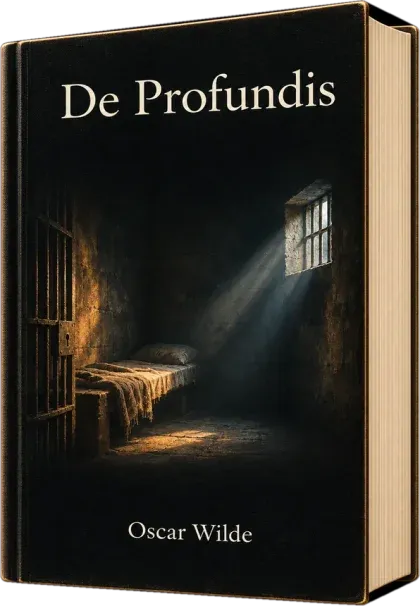
Oscar Wilde
De Profundis
In prison, Oscar Wilde inhabits a world where every day returns wearing the face of yesterday. Beyond its walls lie the pleasures he once pursued, the society that applauded him, and a home altered by death. His wife comes in person to tell him that his mother is gone. Yet amid disgrace, a public gesture of respect reaches him with an unexpected tenderness. Stripped of reputation and freedom, he begins to confront his own part in his ruin—and the possibility that something might survive it. When the world has finished judging a man, how can he begin to live with himself?
- Reading time
- About 1 h 10 min
- With the voice
- 1 h 33 min
- Length
- 17,735 words · 4 chapters
- Level
- B2 CEFR
Read the opening · Chapter 1 · 7 min
“For us there is only one season, the season of sorrow.”
The first minutes of Chapter 1, the way the Lightkeeper app reads it: one line of words past an amber letter, with the voice. Switch to Page to see the whole paragraph.
End of the opening
Chapter 1 goes on in the app.
You caught 0 gems. The rest of the book waits in the app.
Text: Oscar Wilde. Tap the ribbon to pause; tap while a line shimmers to catch it.
Who’s who
De Profundis characters
-
Oscar Wilde
The imprisoned writer confronts public disgrace, bereavement, and his own responsibility for his downfall. He seeks a way to absorb suffering into his life without surrendering his capacity for love or art.
-
R---
An affectionate friend whose loyalty offers Wilde comfort during imprisonment. Wilde looks towards his companionship as a connection to the life beyond confinement.
First named in Chapter 1
-
André Gide
A literary interlocutor whom Wilde remembers from a conversation in a Paris café. Their discussion of Plato and Christ belongs to Wilde’s continuing exploration of art and spiritual imagination.
First named in Chapter 2
-
M---
A friend associated with Wilde’s hopes for companionship and recovery. Together with R---, M--- figures in his imagined retreat by the sea.
First named in Chapter 4
What happens
De Profundis summary
Spoilers below.
The Days That Do Not Pass
In prison, time has ceased to travel. It circles Oscar Wilde, bringing back the same hours, the same suffering, until yesterday and tomorrow seem merely different names for his confinement. Into this suspended life his wife comes bearing the news of his mother’s death. Grief reaches him where he cannot answer it with any ordinary act of love; he must receive the loss and remain.
Outside, the world has learned to turn away. His own class guards its thresholds against disgrace, while among the poor he discovers a sympathy less anxious about respectability. A public gesture of respect becomes something he can carry inward, a small warmth against the cold of humiliation. Affection still exists; he has not been wholly erased from the hearts of others. Yet neither kindness nor cruelty can settle the question now waiting beside him through every repetitive day: what shall he make of the life that remains?
Inside the book
4 chapters
- Chapter 1
- Chapter 2 If pleasure wears a mask and sorrow does not, where does the truth of a life begin?
- Chapter 3 In a prison cell, a Greek Testament raises a question: could these be Christ’s own words?
- Chapter 4 Hamlet’s old friends find a dreamer beneath an intolerable burden: how can a poet answer the call to act?
Lines worth keeping
De Profundis quotes
Most people are other people. Their thoughts are some one else’s opinions, their lives a mimicry, their passions a quotation.
With freedom, flowers, books, and the moon, who could not be perfectly happy?
. . . Suffering is one very long moment. We cannot divide it by seasons. We can only record its moods, and chronicle their return.
Where there is sorrow there is holy ground.
To regret one’s own experiences is to arrest one’s own development. To deny one’s own experiences is to put a lie into the lips of one’s own life.
Society takes upon itself the right to inflict appalling punishment on the individual, but it also has the supreme vice of shallowness, and fails to realise what it has done. When the man’s punishment is over, it leaves him to himself; that is to say, it abandons him at the very moment when its highest duty towards him begins.
ThemesSuffering and artistic truthHumility and self-renewalImagination as compassionDisgrace and social exclusionFriendship and limited sympathyNature’s healing presence
Questions
Before you start
How long does it take to read De Profundis?
De Profundis is 17,735 words. At an average adult pace for fiction, about 260 words a minute (Brysbaert, 2019), that’s about 1 h 10 min. With the voice at normal speed it takes 1 h 33 min, and about 1 h 2 min at 1.5×.
Is there a De Profundis audiobook with the text?
Yes. In Lightkeeper the voice reads while the words move past one amber letter, so your eyes and ears stay on the same word. Speed it up or slow it down and the voice keeps pace. The opening of Chapter 1 is on this page to try.
What reading level is De Profundis?
B2 on the CEFR scale, which runs from A1, the easiest, to C2.
Read all of De Profundis in Lightkeeper
With the voice, the gems to find and the characters to talk to. On iPhone and Android.
More from the shelf
More by Oscar Wilde and others
-
 The Canterville Ghost Oscar Wilde 1 h · B2
-
 The Happy Prince and Other Stories Oscar Wilde 4 h 25 min · B1
-
 The Picture of Dorian Gray Oscar Wilde 7 h 30 min · B1
-
 To the Lighthouse Virginia Woolf 6 h 30 min · B2
-
 Gulliver’s Travels Jonathan Swift 9 h 20 min · C1
-
 The Curious Case of Benjamin Button and Other Stories F. Scott Fitzgerald 3 h 40 min · B2