
Miguel de Cervantes · Don Quixote
Don Quixote Part 2, Chapter 17 summary
- Reading time
- About 16 min
- With the voice
- 22 min
- Length
- 4,229 words
- In the book
- 69 of 126 chapters
Summary
What happens in Part 2, Chapter 17
Spoilers for this chapter only.
Summoned while buying curds, Sancho puts them in Don Quixote’s helmet; when they spill over his master’s head, he blames enchanters. Don Quixote stops a cart carrying two lions as presents for the King and demands to fight them. Despite warnings, he threatens the keeper into opening the male lion’s cage, while Sancho, Don Diego, and the carter retreat to safety. The lion looks out and lies down again, and the keeper persuades Don Quixote that accepting the unanswered challenge is sufficient proof of courage. Don Quixote recalls his companions, orders compensation for the delay, and adopts the name Knight of the Lions. As they resume their journey, he explains to Don Diego why he considers rashness preferable to cowardice in a knight-errant. They reach Don Diego’s village and house, where Don Quixote has accepted an invitation to rest.
Listen and read · Part 2, Chapter 17 · 1.5 min
“Wherein is shown the furthest and highest point which the unexampled courage of Don Quixote reached or could reach…”
The opening of Part 2, Chapter 17, the way the Lightkeeper app reads it: one line of words past an amber letter, with the voice. Switch to Page to see the whole paragraph.
End of the opening
Part 2, Chapter 17 goes on in the app.
The rest of the book waits in the app.
Text: Miguel de Cervantes. Tap the ribbon to pause.
Who’s who
Characters in Part 2, Chapter 17
In the order they are named in this chapter.
-
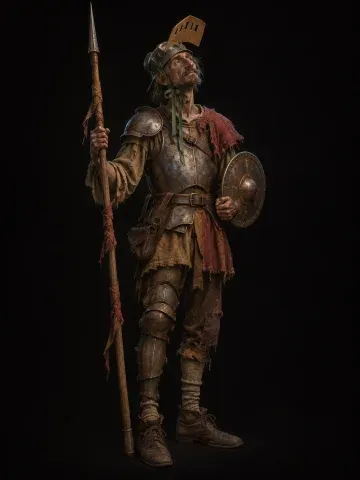
Don Quixote
A gentleman of La Mancha who models his life on books of chivalry and rides out to defend the helpless. Courageous, generous, and dangerously certain of his visions, he seeks honour and the favour of Dulcinea.
-
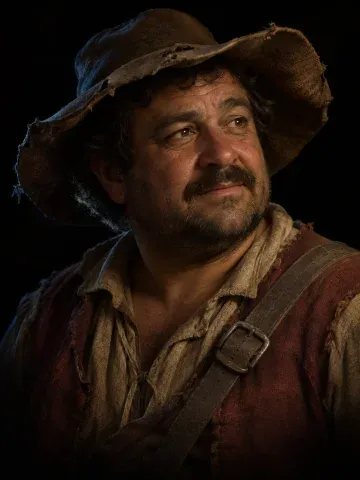
Sancho Panza
A labourer who becomes Don Quixote’s squire in hopes of governing an island. His appetite, proverbs, and practical judgment accompany a growing affection for his extraordinary master.
-
Dulcinea del Toboso
The magnificent lady Don Quixote imagines in the person of the farm-girl Aldonza Lorenzo. Unaware of the devotion bestowed upon her, she becomes the distant purpose of his deeds.
Lines worth keeping
Don Quixote Part 2, Chapter 17 quotes
So far did his unparalleled madness go; but the noble lion, more courteous than arrogant, not troubling himself about silly bravado, after having looked all round, as has been said, turned about and presented his hindquarters to Don Quixote, and very coolly and tranquilly lay down again in the cage.
The enchanters may be able to rob me of good fortune, but of fortitude and courage they cannot.”
I, then, as it has fallen to my lot to be a member of knight-errantry, cannot avoid attempting all that to me seems to come within the sphere of my duties; thus it was my bounden duty to attack those lions that I just now attacked, although I knew it to be the height of rashness; for I know well what valour is, that it is a virtue that occupies a place between two vicious extremes, cowardice and temerity; but it will be a lesser evil for him who is valiant to rise till he reaches the point of rashness, than to sink until he reaches the point of cowardice; for, as it is easier for the prodigal than for the miser to become generous, so it is easier for a rash man to prove truly valiant than for a coward to rise to true valour; and believe me, Señor Don Diego, in attempting adventures it is better to lose by a card too many than by a card too few; for to hear it said, ‘such a knight is rash and daring,’ sounds better than ‘such a knight is timid and cowardly.’
Check yourself
Part 2, Chapter 17 questions
-
Why does Don Quixote demand that the lions be released?
- He wants to help their keeper transfer them between cages.
- He regards them as a challenge sent to him by enchanters.
- He intends to rescue them from captivity and hunger.
- He believes their keeper has stolen them from the King.
Answer
B. He regards them as a challenge sent to him by enchanters.
-
What happens when the male lion’s cage is opened?
- The lion looks around, turns away, and lies down inside.
- The lion runs past Don Quixote and escapes across the plain.
- The lion leaps out, but retreats when Don Quixote advances.
- The lion attacks the keeper, leaving Don Quixote unharmed.
Answer
A. The lion looks around, turns away, and lies down inside.
-
How does Don Quixote defend his willingness to act rashly?
- He argues that a knight’s reputation removes any need for caution.
- He considers rashness closer to true courage than cowardice is.
- He believes that knowing the rules makes recklessness impossible.
- He maintains that dangerous adventures always end successfully.
Answer
B. He considers rashness closer to true courage than cowardice is.
Read all of Part 2, Chapter 17 with the voice
The whole chapter and the rest of Don Quixote wait in the Lightkeeper app, on iPhone and Android.