
Miguel de Cervantes · Don Quixote
Don Quixote Part 2, Chapter 16 summary
- Reading time
- About 15 min
- With the voice
- 20 min
- Length
- 3,843 words
- In the book
- 68 of 126 chapters
Summary
What happens in Part 2, Chapter 16
Spoilers for this chapter only.
Pleased with his recent victory, Don Quixote explains the defeated knight's resemblance to Carrasco as an enchantment, while Sancho stays silent to avoid exposing his own deception concerning Dulcinea. They join a traveller in green, Don Diego de Miranda, who is astonished by Don Quixote's appearance and claims about knight-errantry. Don Diego describes his comfortable, charitable life, prompting Sancho to kiss his foot and call him a saint. When Don Diego complains that his son prefers poetry to law or theology, Don Quixote advises him to respect the young man's inclination and discusses poetic talent, learning, language, and morality. His reasoning makes Don Diego begin to reconsider his suspicion that he is mad. A cart bearing royal flags then approaches, and Don Quixote calls for his helmet in expectation of another adventure.
Listen and read · Part 2, Chapter 16 · 1.5 min
“Of what befell Don Quixote with a discreet gentleman of La Mancha.”
The opening of Part 2, Chapter 16, the way the Lightkeeper app reads it: one line of words past an amber letter, with the voice. Switch to Page to see the whole paragraph.
End of the opening
Part 2, Chapter 16 goes on in the app.
The rest of the book waits in the app.
Text: Miguel de Cervantes. Tap the ribbon to pause.
Who’s who
Characters in Part 2, Chapter 16
In the order they are named in this chapter.
-
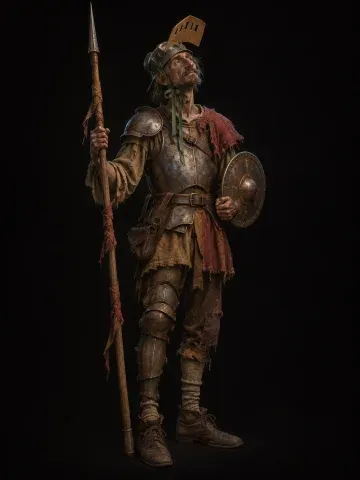
Don Quixote
A gentleman of La Mancha who models his life on books of chivalry and rides out to defend the helpless. Courageous, generous, and dangerously certain of his visions, he seeks honour and the favour of Dulcinea.
-
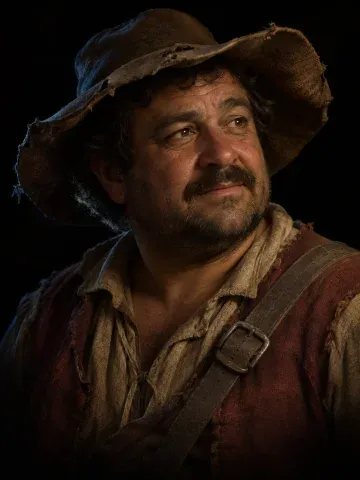
Sancho Panza
A labourer who becomes Don Quixote’s squire in hopes of governing an island. His appetite, proverbs, and practical judgment accompany a growing affection for his extraordinary master.
-
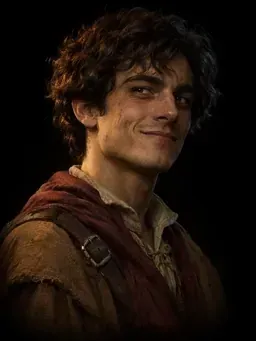
Samson Carrasco
A young bachelor familiar with the published history of Don Quixote’s adventures. He takes an active interest in bringing the wandering knight home, with more confidence than experience.
Lines worth keeping
Don Quixote Part 2, Chapter 16 quotes
To all this Don Quixote said in reply, “Children, señor, are portions of their parents’ bowels, and therefore, be they good or bad, are to be loved as we love the souls that give us life; it is for the parents to guide them from infancy in the ways of virtue, propriety, and worthy Christian conduct, so that when grown up they may be the staff of their parents’ old age, and the glory of their posterity; and to force them to study this or that science I do not think wise, though it may be no harm to persuade them; and when there is no need to study for the sake of pane lucrando, and it is the student’s good fortune that heaven has given him parents who provide him with it, it would be my advice to them to let him pursue whatever science they may see him most inclined to; and though that of poetry is less useful than pleasurable, it is not one of those that bring discredit upon the possessor.
And with regard to what you say, señor, of your son having no great opinion of Spanish poetry, I am inclined to think that he is not quite right there, and for this reason: the great poet Homer did not write in Latin, because he was a Greek, nor did Virgil write in Greek, because he was a Latin; in short, all the ancient poets wrote in the language they imbibed with their mother’s milk, and never went in quest of foreign ones to express their sublime conceptions; and that being so, the usage should in justice extend to all nations, and the German poet should not be undervalued because he writes in his own language, nor the Castilian, nor even the Biscayan, for writing in his.
If the poet be pure in his morals, he will be pure in his verses too; the pen is the tongue of the mind, and as the thought engendered there, so will be the things that it writes down.
Check yourself
Part 2, Chapter 16 questions
-
Why does Sancho avoid challenging Don Quixote's explanation of Dulcinea's transformation?
- He believes the enchanters might punish his doubts.
- He thinks his master has already discovered the truth.
- He fears exposing the deception he invented himself.
- He has promised Carrasco to conceal the whole affair.
Answer
C. He fears exposing the deception he invented himself.
-
What troubles Don Diego about his son's education?
- His son wants to leave his studies and become a knight.
- His son refuses to learn either Latin or Greek.
- His son studies theology but refuses to practise law.
- His son prefers poetry to the law or theology.
Answer
D. His son prefers poetry to the law or theology.
-
What makes Don Diego reconsider his suspicion that Don Quixote is mad?
- Sancho persuades him that all knights behave this way.
- Don Quixote speaks thoughtfully about education and poetry.
- Don Quixote admits that his adventures were imaginary.
- Sancho explains how his master defeated the other knight.
Answer
B. Don Quixote speaks thoughtfully about education and poetry.
Read all of Part 2, Chapter 16 with the voice
The whole chapter and the rest of Don Quixote wait in the Lightkeeper app, on iPhone and Android.