
Miguel de Cervantes · Don Quixote
Don Quixote Part 1, Chapter 50 summary
- Reading time
- About 10 min
- With the voice
- 14 min
- Length
- 2,631 words
- In the book
- 50 of 126 chapters
Summary
What happens in Part 1, Chapter 50
Spoilers for this chapter only.
Don Quixote defends books of chivalry against the canon’s objections, describing an imaginary adventure through a boiling lake into a magnificent enchanted palace. He says these books bring pleasure and that knight-errantry has made him virtuous, and he hopes to gain power so that he can reward his friends. Sancho asks for his promised county and proposes letting others govern it while he enjoys the income, but the canon insists that a lord remains responsible for justice. Don Quixote justifies rewarding Sancho by citing the example of Amadís of Gaul. During the company’s meal, a goatherd pursuing a runaway goat arrives and intrigues the listeners by saying that his words to the animal conceal a meaning. Sancho announces that he will take food to the brook, while the others prepare to hear the goatherd’s true story, which he begins with the goat resting beside him.
Listen and read · Part 1, Chapter 50 · 1 min
“Of the shrewd controversy which Don Quixote and the canon held, together with other incidents.”
The opening of Part 1, Chapter 50, the way the Lightkeeper app reads it: one line of words past an amber letter, with the voice. Switch to Page to see the whole paragraph.
End of the opening
Part 1, Chapter 50 goes on in the app.
The rest of the book waits in the app.
Text: Miguel de Cervantes. Tap the ribbon to pause.
Who’s who
Characters in Part 1, Chapter 50
In the order they are named in this chapter.
-
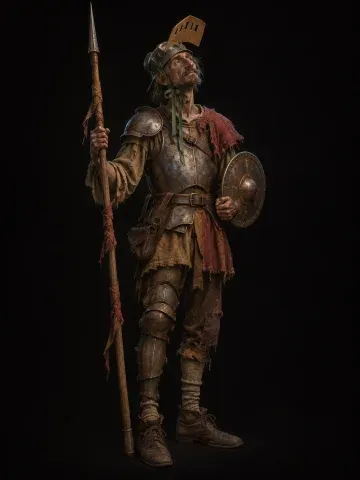
Don Quixote
A gentleman of La Mancha who models his life on books of chivalry and rides out to defend the helpless. Courageous, generous, and dangerously certain of his visions, he seeks honour and the favour of Dulcinea.
-
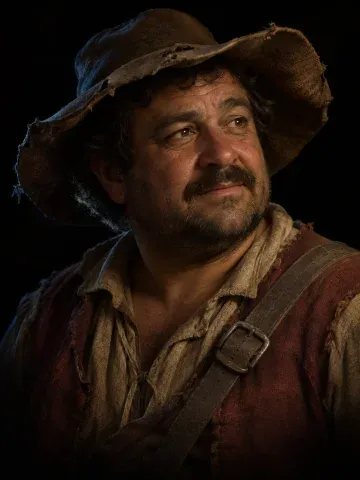
Sancho Panza
A labourer who becomes Don Quixote’s squire in hopes of governing an island. His appetite, proverbs, and practical judgment accompany a growing affection for his extraordinary master.
Lines worth keeping
Don Quixote Part 1, Chapter 50 quotes
For myself I can say that since I have been a knight-errant I have become valiant, polite, generous, well-bred, magnanimous, courteous, dauntless, gentle, patient, and have learned to bear hardships, imprisonments, and enchantments; and though it be such a short time since I have seen myself shut up in a cage like a madman, I hope by the might of my arm, if heaven aid me and fortune thwart me not, to see myself king of some kingdom where I may be able to show the gratitude and generosity that dwell in my heart; for by my faith, señor, the poor man is incapacitated from showing the virtue of generosity to anyone, though he may possess it in the highest degree; and gratitude that consists of disposition only is a dead thing, just as faith without works is dead.
“That, brother Sancho,” said the canon, “only holds good as far as the enjoyment of the revenue goes; but the lord of the seigniory must attend to the administration of justice, and here capacity and sound judgment come in, and above all a firm determination to find out the truth; for if this be wanting in the beginning, the middle and the end will always go wrong; and God as commonly aids the honest intentions of the simple as he frustrates the evil designs of the crafty.”
The canon was astonished at the methodical nonsense (if nonsense be capable of method) that Don Quixote uttered, at the way in which he had described the adventure of the knight of the lake, at the impression that the deliberate lies of the books he read had made upon him, and lastly he marvelled at the simplicity of Sancho, who desired so eagerly to obtain the county his master had promised him.
Check yourself
Part 1, Chapter 50 questions
-
Why does Don Quixote urge the canon to read books of chivalry?
- They explain how to acquire wealth through service.
- They reveal how to distinguish history from invention.
- They offer delight and can relieve melancholy.
- They teach readers how to administer justice.
Answer
C. They offer delight and can relieve melancholy.
-
What responsibility does the canon say Sancho could not escape by letting others govern his county?
- Winning the county through his own military service.
- Following every example found in books of chivalry.
- Ensuring that justice is administered in his domain.
- Personally collecting every payment from his tenants.
Answer
C. Ensuring that justice is administered in his domain.
-
Why does the goatherd offer to tell the company a true story?
- To show that adventures in books of chivalry happened exactly as written.
- To prove that the goat understands everything that people say to her.
- To explain the meaning behind his words and demonstrate his experience.
- To persuade Don Quixote to make him governor instead of Sancho.
Answer
C. To explain the meaning behind his words and demonstrate his experience.
Read all of Part 1, Chapter 50 with the voice
The whole chapter and the rest of Don Quixote wait in the Lightkeeper app, on iPhone and Android.