
Miguel de Cervantes · Don Quixote
Don Quixote Part 1, Chapter 49 summary
- Reading time
- About 11 min
- With the voice
- 15 min
- Length
- 2,823 words
- In the book
- 49 of 126 chapters
Summary
What happens in Part 1, Chapter 49
Spoilers for this chapter only.
Sancho argues that Don Quixote's ordinary bodily needs show that he is not enchanted, but his master insists that enchantments may have changed and that his belief excuses his confinement. Sancho proposes freeing him so they can seek adventures again, and Don Quixote agrees to cooperate. At their stopping place, Sancho obtains his release after Don Quixote gives his word not to leave without permission. The canon urges him to abandon romances of chivalry and read scripture and accounts of historical heroes instead. Don Quixote defends the romances by combining legendary stories, supposed relics, family recollections, and examples of historical knights. The canon acknowledges that some of these knights existed but maintains that neither their existence nor the alleged relics proves the romances true.
Listen and read · Part 1, Chapter 49 · 1.5 min
“Which treats of the shrewd conversation which Sancho Panza held with his master Don Quixote.”
The opening of Part 1, Chapter 49, the way the Lightkeeper app reads it: one line of words past an amber letter, with the voice. Switch to Page to see the whole paragraph.
End of the opening
Part 1, Chapter 49 goes on in the app.
You caught 0 gems. The rest of the book waits in the app.
Text: Miguel de Cervantes. Tap the ribbon to pause; tap while a line shimmers to catch it.
Who’s who
Characters in Part 1, Chapter 49
In the order they are named in this chapter.
-
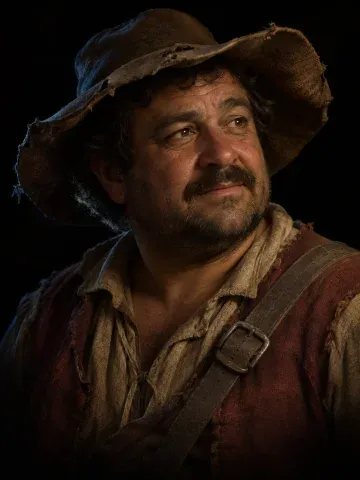
Sancho Panza
A labourer who becomes Don Quixote’s squire in hopes of governing an island. His appetite, proverbs, and practical judgment accompany a growing affection for his extraordinary master.
-
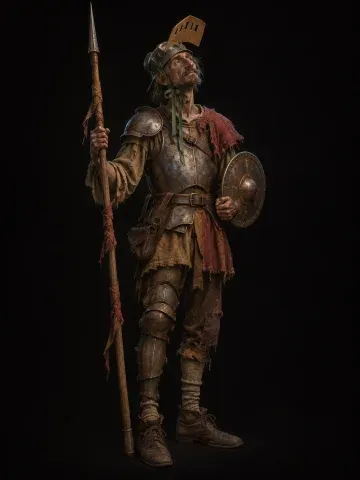
Don Quixote
A gentleman of La Mancha who models his life on books of chivalry and rides out to defend the helpless. Courageous, generous, and dangerously certain of his visions, he seeks honour and the favour of Dulcinea.
-
The curate
Don Quixote’s friend and village priest, who blames chivalric romances for his delusions. He combines concern, literary judgment, and elaborate invention in his efforts to bring him safely home.
Lines worth keeping
Don Quixote Part 1, Chapter 49 quotes
I know and feel that I am enchanted, and that is enough to ease my conscience; for it would weigh heavily on it if I thought that I was not enchanted, and that in a fainthearted and cowardly way I allowed myself to lie in this cage, defrauding multitudes of the succour I might afford to those in need and distress, who at this very moment may be in sore want of my aid and protection.”
That there was a Cid, as well as a Bernardo del Carpio, there can be no doubt; but that they did the deeds people say they did, I hold to be very doubtful.
Check yourself
Part 1, Chapter 49 questions
-
Why does believing himself enchanted ease Don Quixote's conscience?
- It means that his knightly duties have already been fulfilled.
- It assures him that Sancho will receive his promised reward.
- It excuses his confinement while others may need his help.
- It proves that his enemies fear his growing reputation.
Answer
C. It excuses his confinement while others may need his help.
-
What assurance helps secure Don Quixote's release from the cage?
- His pledge to accept the canon as his new master.
- His promise to abandon books of chivalry permanently.
- His agreement to surrender Rocinante to the curate.
- His word as a knight not to leave without permission.
Answer
D. His word as a knight not to leave without permission.
-
What distinction does the canon maintain when answering Don Quixote's examples?
- Relics establish the truth of every story about their owners.
- Spanish knights deserve belief, whereas foreign knights do not.
- Some knights existed, but their legendary exploits remain doubtful.
- Ancient romances are reliable, whereas recent romances are false.
Answer
C. Some knights existed, but their legendary exploits remain doubtful.
Read all of Part 1, Chapter 49 with the voice
The whole chapter and the rest of Don Quixote wait in the Lightkeeper app, on iPhone and Android.