
Miguel de Cervantes · Don Quixote
Don Quixote Part 1, Chapter 38 summary
- Reading time
- About 6 min
- With the voice
- 8 min
- Length
- 1,641 words
- In the book
- 38 of 126 chapters
Summary
What happens in Part 1, Chapter 38
Spoilers for this chapter only.
Don Quixote continues his discourse by describing soldiers’ poverty, injuries, and limited chances of reward. He argues that arms deserve precedence over letters because they protect the order on which laws depend and expose their practitioners to greater suffering and danger. He describes siege warfare and naval combat, then condemns firearms for allowing a coward’s random shot to kill a courageous man. He worries that such a death might prevent him from achieving fame as a knight-errant, but resolves to accept the greater danger. While he speaks without eating, Sancho urges him to take supper, the listeners pity his attachment to chivalry, and the curate endorses his defence of arms. After supper, Don Fernando asks the captive for his life story; encouraged by the company, the captive promises a true account and begins speaking as everyone falls silent.
Listen and read · Part 1, Chapter 38 · 2 min
“Which treats of the curious discourse Don Quixote delivered on arms and letters.”
The opening of Part 1, Chapter 38, the way the Lightkeeper app reads it: one line of words past an amber letter, with the voice. Switch to Page to see the whole paragraph.
End of the opening
Part 1, Chapter 38 goes on in the app.
The rest of the book waits in the app.
Text: Miguel de Cervantes. Tap the ribbon to pause.
Who’s who
Characters in Part 1, Chapter 38
In the order they are named in this chapter.
-
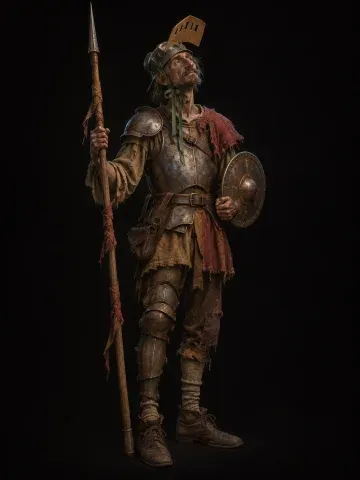
Don Quixote
A gentleman of La Mancha who models his life on books of chivalry and rides out to defend the helpless. Courageous, generous, and dangerously certain of his visions, he seeks honour and the favour of Dulcinea.
-
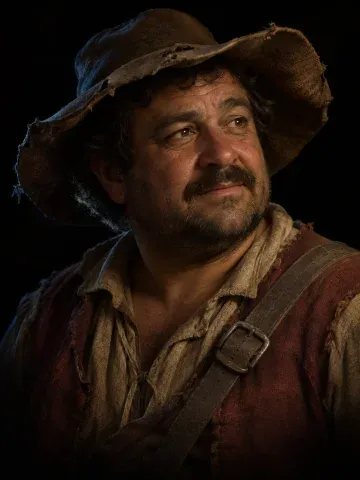
Sancho Panza
A labourer who becomes Don Quixote’s squire in hopes of governing an island. His appetite, proverbs, and practical judgment accompany a growing affection for his extraordinary master.
-
The curate
Don Quixote’s friend and village priest, who blames chivalric romances for his delusions. He combines concern, literary judgment, and elaborate invention in his efforts to bring him safely home.
Lines worth keeping
Don Quixote Part 1, Chapter 38 quotes
Happy the blest ages that knew not the dread fury of those devilish engines of artillery, whose inventor I am persuaded is in hell receiving the reward of his diabolical invention, by which he made it easy for a base and cowardly arm to take the life of a gallant gentleman; and that, when he knows not how or whence, in the height of the ardour and enthusiasm that fire and animate brave hearts, there should come some random bullet, discharged perhaps by one who fled in terror at the flash when he fired off his accursed machine, which in an instant puts an end to the projects and cuts off the life of one who deserved to live for ages to come.
It excited fresh pity in those who had heard him to see a man of apparently sound sense, and with rational views on every subject he discussed, so hopelessly wanting in all, when his wretched unlucky chivalry was in question.
Check yourself
Part 1, Chapter 38 questions
-
How does Don Quixote compare the soldier’s hardships and rewards with those of men of letters?
- The soldier endures equal hardships and receives equal rewards.
- The soldier endures greater hardships but receives smaller rewards.
- The soldier endures fewer hardships but receives smaller rewards.
- The soldier endures greater hardships but receives greater rewards.
Answer
B. The soldier endures greater hardships but receives smaller rewards.
-
Why does Don Quixote feel uneasy about firearms?
- They allow a random shot to end a brave knight’s pursuit of glory.
- They force knights to spend their fortunes on new equipment.
- They require knights to master unfamiliar methods of combat.
- They make rulers unwilling to reward a brave knight’s service.
Answer
A. They allow a random shot to end a brave knight’s pursuit of glory.
-
What does the captive promise the company before beginning his account?
- An invented adventure shaped to entertain his listeners.
- An account of Zoraida’s life told entirely in her words.
- A brief argument supporting Don Quixote’s view of warfare.
- A true story that may surpass carefully crafted fiction.
Answer
D. A true story that may surpass carefully crafted fiction.
Read all of Part 1, Chapter 38 with the voice
The whole chapter and the rest of Don Quixote wait in the Lightkeeper app, on iPhone and Android.