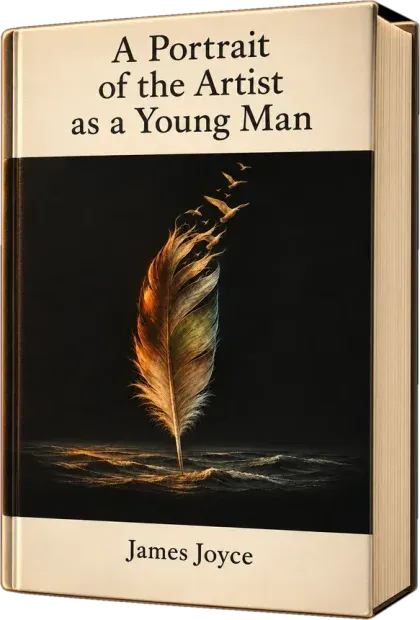
James Joyce · 1918
A Portrait of the Artist as a Young Man
For Stephen Dedalus, the world begins in songs, strange words, and the warmth of home. Then comes Clongowes Wood College: cold corridors, boys who mock his name, and rules whose justice he cannot understand. Beyond the school gates, Ireland’s quarrels divide the people he loves. At Christmas dinner, faith and politics turn familiar voices savage; in the classroom, a priest’s punishment makes obedience feel like betrayal. Small, watchful, and fiercely alive to language, Stephen must discover whether his own judgement deserves to be heard. His struggle begins with a child’s urgent questions about belonging, authority, and the cost of speaking. When everyone claims the right to guide him, whose voice can he trust?
- Reading time
- About 5 h 25 min
- With the voice
- 7 h 56 min
- Length
- 84,812 words · 14 chapters
- Level
- B2 CEFR
Read the opening · Chapter 1 (1) · 8 min
“Once upon a time and a very good time it was there was a moocow coming down along the road and this moocow that was…”
The first minutes of Chapter 1 (1), the way the Lightkeeper app reads it: one line of words past an amber letter, with the voice. Switch to Page to see the whole paragraph.
End of the opening
Chapter 1 (1) goes on in the app.
You caught 0 gems. The rest of the book waits in the app.
Text: James Joyce. Tap the ribbon to pause; tap while a line shimmers to catch it.
Who’s who
A Portrait of the Artist as a Young Man characters
-
Stephen Dedalus
A sensitive Irish boy whose fascination with words develops into an exacting artistic ambition. He struggles to understand what he owes his family, his faith, and his country.
First named in Chapter 1 (1)
-
Simon Dedalus
Stephen’s father, a sociable man sustained by political passions, old friendships, and memories of better days. He wants to preserve his standing and his connection with his son as the family’s finances deteriorate.
First named in Chapter 1 (2)
-
Mrs Dedalus
Stephen’s mother, whose practical care holds the struggling household together. She hopes her son will remain close to his family and faithful to the Church.
-
Dante
An imposing figure in Stephen’s childhood household, associated with lessons, warnings, and religious certainty. Her loyalty to the Church brings her into bitter conflict with the family’s supporters of Parnell.
First named in Chapter 1 (1)
-
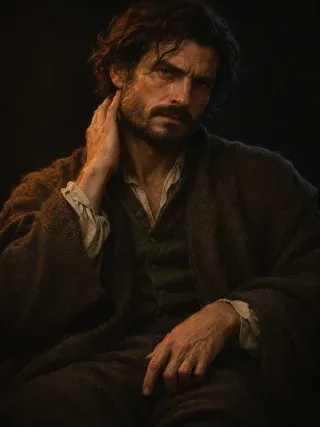
Mr Casey
A friend of Stephen’s father and a passionate supporter of Parnell. He wants Ireland’s political hopes defended against the clergy’s interference.
First named in Chapter 1 (1)
-
Father Arnall
A priest Stephen first knows as a schoolteacher and later encounters as a retreat preacher. He seeks to direct his pupils through religious instruction, examination of conscience, and repentance.
First named in Chapter 1 (1)
-
Emma
A young woman who becomes the focus of Stephen’s romantic longing and poetic imagination. Her independent presence repeatedly unsettles the meanings he assigns to their encounters.
First named in Chapter 3 (2)
-
Cranly
Stephen’s university friend and an important listener to his most private arguments. He presses Stephen to consider the human cost of his convictions, especially where his mother is concerned.
First named in Chapter 5 (1)
In the app you can talk to 3 of the characters. They answer from the page you’re on, so the story ahead stays yours to find. How it works
What happens
A Portrait of the Artist as a Young Man summary
Spoilers below.
The Small World
Before the world had settled into its proper shapes, it was a story his father told, a song, the warmth of his mother, the queer pleasure of a word moving about in his mouth. Stephen Dedalus listened. Colours belonged to people and feelings; threats could become terrible pictures. He would marry Eileen Vance when they were grown. But already there were things one must not say, affections someone could forbid.
At Clongowes, the other boys seemed to know how everything was done. They ran and shouted and asked about his father. Stephen was small and cold. Home existed at a distance measured in days until the holidays. He sought its warmth inside remembered words.
Wells pushed him into the dirty ditch. Afterwards came the question about kissing his mother: either answer made the boys laugh. There was no right answer, then. When sickness took him, Stephen would not tell on Wells. In the infirmary Brother Michael was kind; Athy talked; the familiar world loosened its hold. Stephen imagined himself dead, the sorrow of those who would know too late. A funeral song swelled within him. In his troubled sleep a crowd mourned Parnell, and Dante passed proudly through its grief.
At Christmas he sat with the grown people, admitted at last to the brightness and abundance of their dinner. Then the talk turned upon the priests and Parnell. Dante defended the Church. His father and Mr Casey accused its ministers of destroying Ireland’s leader. His mother pleaded for peace; Uncle Charles tried to quiet them. Mr Casey told his coarse, triumphant story of answering an insult to Kitty O’Shea with tobacco juice. The voices rose. Dante departed in fierce satisfaction, Mr Casey broke into sobs, and Stephen saw his father weeping. The people who knew what was right could not agree. Their knowledge had made them cruel.
Back at school, his spectacles were broken, and Father Arnall excused him from his work. Father Dolan called it a trick and struck his hands with the pandybat. Pain filled the place where justice should have been. Urged by the boys, Stephen went trembling to the rector and told what had happened. The rector heard him and promised to speak to Father Dolan.
Outside, the boys welcomed him with cries. He had spoken and had not been destroyed. Evening opened about him, gentle and free. He would be quiet; he would bear no grudge. For the moment, the world had room for him.
Inside the book
14 chapters
- Chapter 1 (1)
- Chapter 1 (2) Around the Christmas hearth, Stephen watches the grown-ups and wonders at the secrets they carry.
- Chapter 1 (3) Whispers of runaway boys draw Stephen towards a secret that makes the familiar sacristy seem strange.
- Chapter 2 In Blackrock, Stephen’s summer begins beside Uncle Charles, whose smoky retreat has a grandeur of its own.
- Chapter 3 (1) As dusk fills the schoolroom, Stephen hungers for dinner and for the secret streets beyond.
- Chapter 3 (2) In the chapel, an old master’s voice brings Stephen’s childhood close again—but what will it ask of him?
- Chapter 3 (3) The sermon enters a hell where even companionship becomes a torment, and no human bond offers shelter.
- Chapter 3 (4) Outside his bedroom, Stephen hesitates: how has a familiar doorway become the entrance to such darkness?
- Chapter 4 Stephen gives each day to a sacred mystery, seeking to make every waking thought an act of devotion.
- Chapter 5 (1) Over watery tea and scattered pawn tickets, Stephen faces another morning already slipping away.
- Chapter 5 (2) A pledge for universal peace puts Stephen’s temper—and Cranly’s Latin—to the test.
- Chapter 5 (3) At dawn, Stephen wakes to a music almost too faint to hold: can the imagination give it flesh?
- Chapter 5 (4) On the library steps, Stephen watches birds circle the evening sky, trying to count what will not be still.
- Chapter 5 (5) In his diary, Stephen tests the meaning of freedom against Cranly’s troubling appeal to a mother’s love.
Lines worth keeping
A Portrait of the Artist as a Young Man quotes
Once upon a time and a very good time it was there was a moocow coming down along the road and this moocow that was coming down along the road met a nicens little boy named baby tuckoo. … His father told him that story: his father looked at him through a glass: he had a hairy face. He was baby tuckoo.
When the soul of a man is born in this country there are nets flung at it to hold it back from flight. You talk to me of nationality, language, religion. I shall try to fly by those nets.
I will not serve that in which I no longer believe, whether it call itself my home, my fatherland, or my church: and I will try to express myself in some mode of life or art as freely as I can and as wholly as I can, using for my defence the only arms I allow myself to use—silence, exile and cunning.
I go to encounter for the millionth time the reality of experience and to forge in the smithy of my soul the uncreated conscience of my race.
But you could not have a green rose. But perhaps somewhere in the world you could.
He wanted to cry quietly but not for himself: for the words, so beautiful and sad, like music.
ThemesThe making of an artistFaith, guilt, and desireFamily love and estrangementIrish identity and political allegianceLanguage and self-possessionFreedom, exile, and solitude
Questions
Before you start
How long does it take to read A Portrait of the Artist as a Young Man?
A Portrait of the Artist as a Young Man is 84,812 words. At an average adult pace for fiction, about 260 words a minute (Brysbaert, 2019), that’s about 5 h 25 min. With the voice at normal speed it takes 7 h 56 min, and about 5 h 17 min at 1.5×.
Is there a A Portrait of the Artist as a Young Man audiobook with the text?
Yes. In Lightkeeper the voice reads while the words move past one amber letter, so your eyes and ears stay on the same word. Speed it up or slow it down and the voice keeps pace. The opening of Chapter 1 (1) is on this page to try.
What reading level is A Portrait of the Artist as a Young Man?
B2 on the CEFR scale, which runs from A1, the easiest, to C2.
Read all of A Portrait of the Artist as a Young Man in Lightkeeper
With the voice, the gems to find and the characters to talk to. On iPhone and Android.
More from the shelf