
Miguel de Cervantes · Don Quixote
Don Quixote Part 2, Chapter 31 summary
Which treats of many and great matters.
- Reading time
- About 13 min
- With the voice
- 17 min
- Length
- 3,270 words
- In the book
- 83 of 126 chapters
Summary
What happens in Part 2, Chapter 31
Spoilers for this chapter only.
The duke arranges an elaborate reception that convinces Don Quixote he is being honoured as a true knight-errant. Sancho quarrels with Doña Rodriguez after asking her to have Dapple stabled, and the duke promises that the ass will be cared for. In private, Don Quixote warns Sancho that his behaviour could damage his master’s reputation, and Sancho promises to speak carefully. At dinner, Sancho tells a rambling story about a gentleman whose rank outweighs the seating arrangements, embarrassing Don Quixote and amusing their hosts. The duchess asks about Dulcinea, whom Don Quixote describes as enchanted, while Sancho claims that he first thought of the enchantment. Recognizing Don Quixote, the household ecclesiastic condemns the duke for encouraging his delusions and tells the knight to return home. Don Quixote rises angrily to answer, but his reply is deferred to the next chapter.
Listen and read · Part 2, Chapter 31 · 2 min
“Supreme was the satisfaction that Sancho felt at seeing himself, as it seemed, an established favourite with the…”
The opening of Part 2, Chapter 31, the way the Lightkeeper app reads it: one line of words past an amber letter, with the voice. Switch to Page to see the whole paragraph.
End of the opening
Part 2, Chapter 31 goes on in the app.
You caught 0 gems. The rest of the book waits in the app.
Text: Miguel de Cervantes. Tap the ribbon to pause; tap while a line shimmers to catch it.
Who’s who
Characters in Part 2, Chapter 31
In the order they are named in this chapter.
-
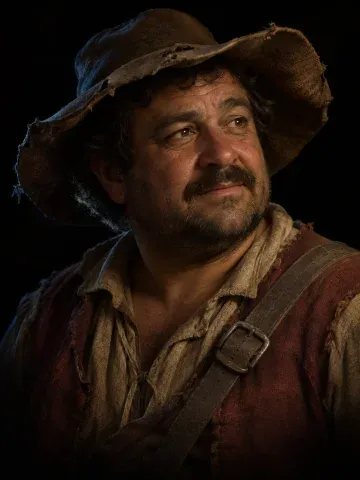
Sancho Panza
A labourer who becomes Don Quixote’s squire in hopes of governing an island. His appetite, proverbs, and practical judgment accompany a growing affection for his extraordinary master.
-
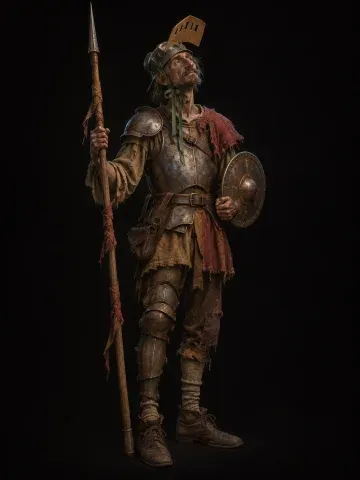
Don Quixote
A gentleman of La Mancha who models his life on books of chivalry and rides out to defend the helpless. Courageous, generous, and dangerously certain of his visions, he seeks honour and the favour of Dulcinea.
-
The duchess
A reader of Don Quixote’s history who welcomes the travellers and closely questions Sancho. Her curiosity and taste for elaborate amusement make her a skilled director of their supposed enchantments.
-
The duke
An aristocrat who recognises Don Quixote and Sancho from their printed adventures. He uses his household and authority to stage the chivalric wonders that entertain him.
Lines worth keeping
Don Quixote Part 2, Chapter 31 quotes
At length the duke came out to take her down, and as they entered a spacious court two fair damsels came forward and threw over Don Quixote’s shoulders a large mantle of the finest scarlet cloth, and at the same instant all the galleries of the court were lined with the menservants and womenservants of the household, crying, “Welcome, flower and cream of knight-errantry!” while all or most of them flung pellets filled with scented water over Don Quixote and the duke and duchess; at all which Don Quixote was greatly astonished, and this was the first time that he thoroughly felt and believed himself to be a knight-errant in reality and not merely in fancy, now that he saw himself treated in the same way as he had read of such knights being treated in days of yore.
“So, as I was saying,” continued Sancho, “as the pair of them were going to sit down to table, as I said, the labourer insisted upon the gentleman’s taking the head of the table, and the gentleman insisted upon the labourer’s taking it, as his orders should be obeyed in his house; but the labourer, who plumed himself on his politeness and good breeding, would not on any account, until the gentleman, out of patience, putting his hands on his shoulders, compelled him by force to sit down, saying, ‘Sit down, you stupid lout, for wherever I sit will be the head to you;’ and that’s the story, and, troth, I think it hasn’t been brought in amiss here.”
The ecclesiastic, when he heard them talking of giants and caitiffs and enchantments, began to suspect that this must be Don Quixote of La Mancha, whose story the duke was always reading; and he had himself often reproved him for it, telling him it was foolish to read such fooleries; and becoming convinced that his suspicion was correct, addressing the duke, he said very angrily to him, “Señor, your excellence will have to give account to God for what this good man does. This Don Quixote, or Don Simpleton, or whatever his name is, cannot, I imagine, be such a blockhead as your excellence would have him, holding out encouragement to him to go on with his vagaries and follies.”
Check yourself
Part 2, Chapter 31 questions
-
Why have the household servants been instructed to receive Don Quixote with elaborate ceremonies?
- To reward him for rescuing the duchess from immediate danger.
- To persuade him to enter the duke’s service as a household guard.
- To persuade him that he is being received as a true knight-errant.
- To prepare him for an official appointment promised by the duke.
Answer
C. To persuade him that he is being received as a true knight-errant.
-
What does the gentleman’s final remark in Sancho’s story imply?
- The gentleman’s superiority does not depend on where he sits.
- A labourer should refuse to dine with anyone of higher rank.
- The head of the table belongs to whoever claims it first.
- A guest becomes his host’s superior by accepting the best seat.
Answer
A. The gentleman’s superiority does not depend on where he sits.
-
Why does the ecclesiastic rebuke the duke?
- He believes the duke has granted Sancho too much authority.
- He believes the duke is encouraging Don Quixote’s delusions.
- He believes the duke has neglected the comfort of his guests.
- He believes the duke is concealing news about Dulcinea.
Answer
B. He believes the duke is encouraging Don Quixote’s delusions.
Read all of Part 2, Chapter 31 with the voice
The whole chapter and the rest of Don Quixote wait in the Lightkeeper app, on iPhone and Android.