
Miguel de Cervantes · Don Quixote
Don Quixote Part 2, Chapter 13 summary
- Reading time
- About 9 min
- With the voice
- 13 min
- Length
- 2,469 words
- In the book
- 65 of 126 chapters
Summary
What happens in Part 2, Chapter 13
Spoilers for this chapter only.
While their masters discuss their loves, Sancho and the squire of the Grove withdraw to discuss the hardships and hoped-for rewards of serving knights-errant. The other squire recommends returning home, and their conversation turns to their children and a disagreement over an insulting expression used as praise. Sancho admits that dreams of wealth keep him in service, while his companion reveals that his own master is acting mad to restore another knight's senses. Sancho nevertheless defends his master's kindness and explains his affection for him. The squire of the Grove shares a large rabbit pasty and wine, prompting Sancho to demonstrate his knowledge of wine and recount his relatives' skill at tasting it. Sancho decides to remain with his master until Saragossa, and the two squires eventually fall asleep over their food and nearly empty wineskin.
Listen and read · Part 2, Chapter 13 · 1.5 min
“In which is continued the adventure of the Knight of the Grove, together with the sensible, original, and tranquil…”
The opening of Part 2, Chapter 13, the way the Lightkeeper app reads it: one line of words past an amber letter, with the voice. Switch to Page to see the whole paragraph.
End of the opening
Part 2, Chapter 13 goes on in the app.
The rest of the book waits in the app.
Text: Miguel de Cervantes. Tap the ribbon to pause.
Who’s who
Characters in Part 2, Chapter 13
In the order they are named in this chapter.
-
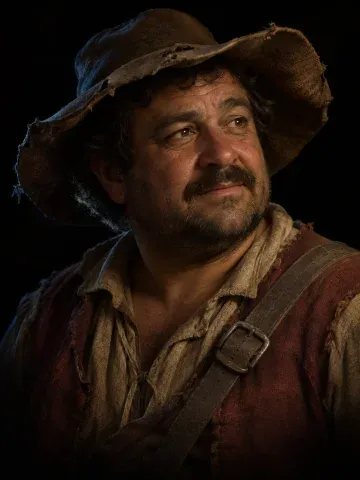
Sancho Panza
A labourer who becomes Don Quixote’s squire in hopes of governing an island. His appetite, proverbs, and practical judgment accompany a growing affection for his extraordinary master.
Lines worth keeping
Don Quixote Part 2, Chapter 13 quotes
“There’s why they say that ‘covetousness bursts the bag,’ ” said he of the Grove; “but if you come to talk of that sort, there is not a greater one in the world than my master, for he is one of those of whom they say, ‘the cares of others kill the ass;’ for, in order that another knight may recover the senses he has lost, he makes a madman of himself and goes looking for what, when found, may, for all I know, fly in his own face.”
“Mine is not that,” said Sancho; “I mean he has nothing of the rogue in him; on the contrary, he has the soul of a pitcher; he has no thought of doing harm to anyone, only good to all, nor has he any malice whatever in him; a child might persuade him that it is night at noonday; and for this simplicity I love him as the core of my heart, and I can’t bring myself to leave him, let him do ever such foolish things.”
Check yourself
Part 2, Chapter 13 questions
-
What rewards do Sancho and the squire of the Grove expect for their service?
- Sancho expects a county; the other squire expects a royal marriage.
- Sancho expects a royal marriage; the other squire expects a county.
- Sancho expects a canonry; the other squire expects an island government.
- Sancho expects an island government; the other squire expects a canonry.
Answer
D. Sancho expects an island government; the other squire expects a canonry.
-
Why does Sancho say he cannot bring himself to leave his master?
- He fears his master would punish him for abandoning his service.
- He believes his master has finally recovered his sound judgment.
- He loves his master's goodness despite recognizing his foolishness.
- He knows his master will immediately make him an island governor.
Answer
C. He loves his master's goodness despite recognizing his foolishness.
-
How does Sancho answer the final proposal to abandon their adventures?
- He will stay until his master reaches Saragossa, then reconsider.
- He decides to accompany the other squire back to his village.
- He agrees to return home as soon as their meal is finished.
- He promises to remain a squire until he receives his government.
Answer
A. He will stay until his master reaches Saragossa, then reconsider.
Read all of Part 2, Chapter 13 with the voice
The whole chapter and the rest of Don Quixote wait in the Lightkeeper app, on iPhone and Android.