
Miguel de Cervantes · Don Quixote
Don Quixote Part 2, Chapter 1 summary
- Reading time
- About 17 min
- With the voice
- 23 min
- Length
- 4,367 words
- In the book
- 53 of 126 chapters
Summary
What happens in Part 2, Chapter 1
Spoilers for this chapter only.
After nearly a month without visiting Don Quixote, the curate and the barber come to assess his recovery and initially find him speaking sensibly. The curate introduces the threat of a Turkish fleet, and Don Quixote proposes summoning knights-errant to defeat it, revealing his continued belief in chivalric exploits. The barber tells a story about a supposedly recovered madhouse inmate whose claim to be Neptune prevents his release. Don Quixote recognizes the comparison, takes offence, and defends the restoration of knight-errantry. When the curate questions whether the celebrated knights ever existed, Don Quixote insists that they did, and the conversation turns to their appearance and Angelica's choice of Medoro over Roland. Cries from the niece and housekeeper in the courtyard interrupt the discussion, and everyone runs out.
Listen and read · Part 2, Chapter 1 · 1.5 min
“Of the interview the curate and the barber had with Don Quixote about his malady.”
The opening of Part 2, Chapter 1, the way the Lightkeeper app reads it: one line of words past an amber letter, with the voice. Switch to Page to see the whole paragraph.
End of the opening
Part 2, Chapter 1 goes on in the app.
The rest of the book waits in the app.
Text: Miguel de Cervantes. Tap the ribbon to pause.
Who’s who
Characters in Part 2, Chapter 1
In the order they are named in this chapter.
-
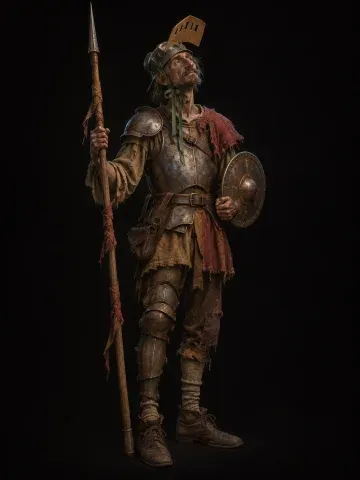
Don Quixote
A gentleman of La Mancha who models his life on books of chivalry and rides out to defend the helpless. Courageous, generous, and dangerously certain of his visions, he seeks honour and the favour of Dulcinea.
Lines worth keeping
Don Quixote Part 2, Chapter 1 quotes
“Those present stood listening to the words and exclamations of the madman; but our licentiate, turning to the chaplain and seizing him by the hands, said to him, ‘Be not uneasy, señor; attach no importance to what this madman has said; for if he is Jupiter and will not send rain, I, who am Neptune, the father and god of the waters, will rain as often as it pleases me and may be needful.’
Sometimes I have not been successful in my purpose, sometimes I have, supporting it upon the shoulders of the truth; which truth is so clear that I can almost say I have with my own eyes seen Amadís of Gaul, who was a man of lofty stature, fair complexion, with a handsome though black beard, of a countenance between gentle and stern in expression, sparing of words, slow to anger, and quick to put it away from him; and as I have depicted Amadís, so I could, I think, portray and describe all the knights-errant that are in all the histories in the world; for by the perception I have that they were what their histories describe, and by the deeds they did and the dispositions they displayed, it is possible, with the aid of sound philosophy, to deduce their features, complexion, and stature.”
“I can well believe,” replied Don Quixote, “that if Sacripante or Roland had been poets they would have given the damsel a trimming; for it is naturally the way with poets who have been scorned and rejected by their ladies, whether fictitious or not, in short by those whom they select as the ladies of their thoughts, to avenge themselves in satires and libels—a vengeance, to be sure, unworthy of generous hearts; but up to the present I have not heard of any defamatory verse against the Lady Angelica, who turned the world upside down.”
Check yourself
Part 2, Chapter 1 questions
-
What measure does Don Quixote propose against the threatened Turkish attack?
- Recruit soldiers from every town along the Spanish coast.
- Concentrate the royal fleet around Naples and Sicily.
- Assemble knights-errant who could defeat the invading forces.
- Send royal advisers to negotiate peace with the enemy.
Answer
C. Assemble knights-errant who could defeat the invading forces.
-
Why does the chaplain leave the licentiate in the madhouse?
- The licentiate admits that his relatives need his property.
- The licentiate reveals that he believes himself to be Neptune.
- The Archbishop withdraws his permission to release him.
- The governor proves that the licentiate forged his letters.
Answer
B. The licentiate reveals that he believes himself to be Neptune.
-
How does Don Quixote answer the curate's doubts about the knights-errant?
- He says their existence matters less than the virtues they represent.
- He accepts that their stories are inventions with useful lessons.
- He insists they existed and claims he can reconstruct their appearance.
- He admits uncertainty and asks the curate to examine their histories.
Answer
C. He insists they existed and claims he can reconstruct their appearance.
Read all of Part 2, Chapter 1 with the voice
The whole chapter and the rest of Don Quixote wait in the Lightkeeper app, on iPhone and Android.