
Miguel de Cervantes · Don Quixote
Don Quixote Part 1, Chapter 47 summary
- Reading time
- About 15 min
- With the voice
- 21 min
- Length
- 3,995 words
- In the book
- 47 of 126 chapters
Summary
What happens in Part 1, Chapter 47
Spoilers for this chapter only.
Don Quixote believes that wicked enchanters have imprisoned him, although Sancho finds physical evidence that their supposed captors are ordinary people. His companions hasten their departure, and he bids farewell to the women at the inn while the curate and barber prepare to accompany him in disguise. The landlord gives the curate another manuscript, which he keeps for later reading. On the road, a canon of Toledo overtakes the procession and asks why Don Quixote is being carried in a cage. Sancho recognises the disguised curate, disputes the enchantment, and protests against his master's confinement, while the curate privately explains their plan to take Don Quixote home and seek a cure for his madness. The canon condemns the implausibility and poor construction of chivalric romances, then describes how their broad possibilities could allow a talented writer to combine literary variety, instruction, and pleasure.
Listen and read · Part 1, Chapter 47 · 1.5 min
“Of the strange manner in which Don Quixote of La Mancha was carried away enchanted, together with other remarkable…”
The opening of Part 1, Chapter 47, the way the Lightkeeper app reads it: one line of words past an amber letter, with the voice. Switch to Page to see the whole paragraph.
End of the opening
Part 1, Chapter 47 goes on in the app.
The rest of the book waits in the app.
Text: Miguel de Cervantes. Tap the ribbon to pause.
Who’s who
Characters in Part 1, Chapter 47
In the order they are named in this chapter.
-
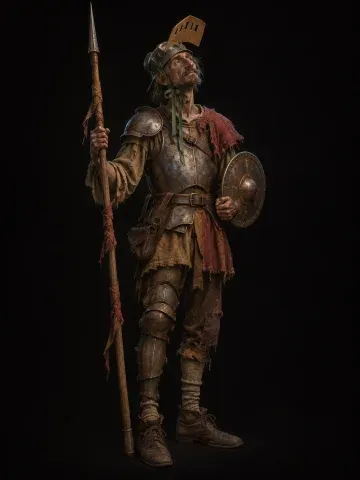
Don Quixote
A gentleman of La Mancha who models his life on books of chivalry and rides out to defend the helpless. Courageous, generous, and dangerously certain of his visions, he seeks honour and the favour of Dulcinea.
-
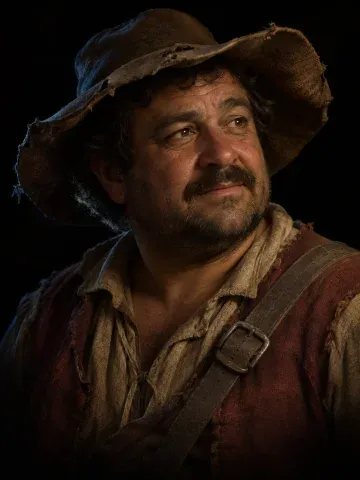
Sancho Panza
A labourer who becomes Don Quixote’s squire in hopes of governing an island. His appetite, proverbs, and practical judgment accompany a growing affection for his extraordinary master.
-
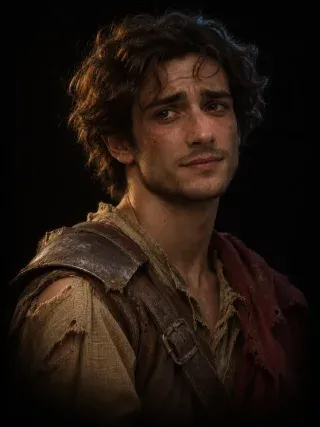
Cardenio
A young gentleman driven into the Sierra Morena by betrayal and anguish over Luscinda. He longs to recover the love and trust that have been taken from him.
-
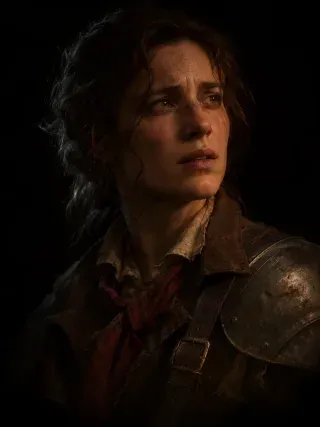
Dorothea
A resourceful young woman abandoned by Don Fernando after his promise of marriage. Seeking recognition and justice, she also lends her knowledge of romances to a plan involving Don Quixote.
-
The curate
Don Quixote’s friend and village priest, who blames chivalric romances for his delusions. He combines concern, literary judgment, and elaborate invention in his efforts to bring him safely home.
Lines worth keeping
Don Quixote Part 1, Chapter 47 quotes
“Marvel not at that, Sancho my friend,” said Don Quixote; “for let me tell thee devils are crafty; and even if they do carry odours about with them, they themselves have no smell, because they are spirits; or, if they have any smell, they cannot smell of anything sweet, but of something foul and fetid; and the reason is that as they carry hell with them wherever they go, and can get no ease whatever from their torments, and as a sweet smell is a thing that gives pleasure and enjoyment, it is impossible that they can smell sweet; if, then, this devil thou speakest of seems to thee to smell of amber, either thou art deceiving thyself, or he wants to deceive thee by making thee fancy he is not a devil.”
Each of us is the son of his own works; and being a man I may come to be pope, not to say governor of an island, especially as my master may win so many that he will not know whom to give them to.
And if, in answer to this, I am told that the authors of books of the kind write them as fiction, and therefore are not bound to regard niceties of truth, I would reply that fiction is all the better the more it looks like truth, and gives the more pleasure the more probability and possibility there is about it. Plots in fiction should be wedded to the understanding of the reader, and be constructed in such a way that, reconciling impossibilities, smoothing over difficulties, keeping the mind on the alert, they may surprise, interest, divert, and entertain, so that wonder and delight joined may keep pace one with the other; all which he will fail to effect who shuns verisimilitude and truth to nature, wherein lies the perfection of writing.
Check yourself
Part 1, Chapter 47 questions
-
How does Don Quixote explain Sancho's discovery that a supposed devil smells sweet?
- The creature has lost its evil nature through contact with a virtuous knight.
- Sancho has touched an ordinary traveller standing among the apparitions.
- The creature's perfume proves that it serves a benevolent enchanter.
- Sancho's senses are mistaken, or the creature is deliberately deceiving him.
Answer
D. Sancho's senses are mistaken, or the creature is deliberately deceiving him.
-
What is the actual purpose of transporting Don Quixote in the cage?
- To deliver him to the Brotherhood for punishment as a highwayman.
- To bring him to the canon for an examination of his adventures.
- To prevent him from interfering with Don Fernando's marriage.
- To take him home and seek a way to cure his madness.
Answer
D. To take him home and seek a way to cure his madness.
-
What merit does the canon ultimately find in books of chivalry?
- Their broad scope can let a gifted writer combine instruction with pleasure.
- Their impossible feats can establish the truth of ancient heroic traditions.
- Their lengthy battles can teach readers the practical skills of military command.
- Their familiar plots can spare readers the effort of following new inventions.
Answer
A. Their broad scope can let a gifted writer combine instruction with pleasure.
Read all of Part 1, Chapter 47 with the voice
The whole chapter and the rest of Don Quixote wait in the Lightkeeper app, on iPhone and Android.