
Miguel de Cervantes · Don Quixote
Don Quixote Part 1, Chapter 19 summary
- Reading time
- About 12 min
- With the voice
- 16 min
- Length
- 3,000 words
- In the book
- 19 of 126 chapters
Summary
What happens in Part 1, Chapter 19
Spoilers for this chapter only.
Sancho attributes their recent misfortunes to Don Quixote's failure to keep a chivalric oath, and his master promises to make amends while also blaming Sancho. Hungry and without shelter after nightfall, they encounter a torchlit procession accompanying a black-covered litter. Imagining an adventure involving a wounded or murdered knight, Don Quixote demands an explanation and attacks when the travellers refuse to stop, scattering the unarmed company. A fallen churchman, Alonzo López, explains that they are transporting a gentleman's remains from Baeza to Segovia and that the man died of fever. While Sancho takes provisions from a baggage mule, Don Quixote defends his conduct, helps free the injured bachelor, and hears his warning of excommunication. Sancho names his master the Knight of the Rueful Countenance because of his appearance, and Don Quixote adopts the title as a chivalric distinction. At Sancho's urging they withdraw to a secluded valley and eat the captured provisions, only to discover that they have neither wine nor water.
Listen and read · Part 1, Chapter 19 · 1.5 min
“Of the shrewd discourse which Sancho held with his master, and of the adventure that befell him with a dead body…”
The opening of Part 1, Chapter 19, the way the Lightkeeper app reads it: one line of words past an amber letter, with the voice. Switch to Page to see the whole paragraph.
End of the opening
Part 1, Chapter 19 goes on in the app.
The rest of the book waits in the app.
Text: Miguel de Cervantes. Tap the ribbon to pause.
Who’s who
Characters in Part 1, Chapter 19
In the order they are named in this chapter.
-
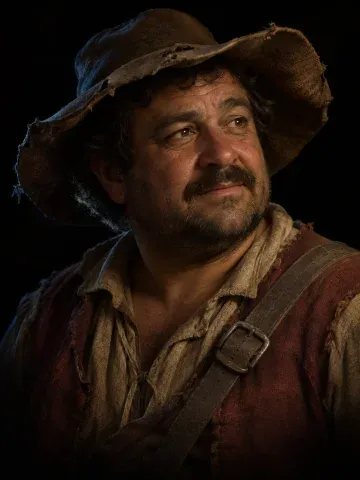
Sancho Panza
A labourer who becomes Don Quixote’s squire in hopes of governing an island. His appetite, proverbs, and practical judgment accompany a growing affection for his extraordinary master.
-
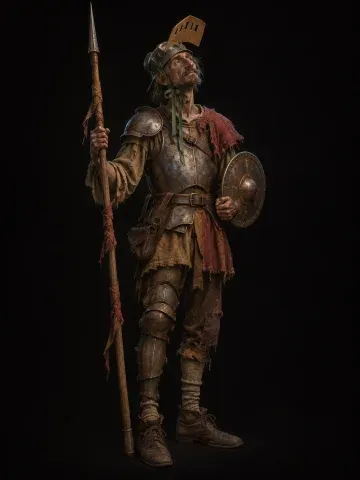
Don Quixote
A gentleman of La Mancha who models his life on books of chivalry and rides out to defend the helpless. Courageous, generous, and dangerously certain of his visions, he seeks honour and the favour of Dulcinea.
Lines worth keeping
Don Quixote Part 1, Chapter 19 quotes
“I do not know how that about righting wrongs can be,” said the bachelor, “for from straight you have made me crooked, leaving me with a broken leg that will never see itself straight again all the days of its life; and the injury you have redressed in my case has been to leave me injured in such a way that I shall remain injured forever; and the height of misadventure it was to fall in with you who go in search of adventures.”
“It is not that,” replied Don Quixote, “but because the sage whose duty it will be to write the history of my achievements must have thought it proper that I should take some distinctive name as all knights of yore did; one being ‘He of the Burning Sword,’ another ‘He of the Unicorn,’ this one ‘He of the Damsels,’ that ‘He of the Phoenix,’ another ‘The Knight of the Griffin,’ and another ‘He of the Death,’ and by these names and designations they were known all the world round; and so I say that the sage aforesaid must have put it into your mouth and mind just now to call me ‘The Knight of the Rueful Countenance,’ as I intend to call myself from this day forward; and that the said name may fit me better, I mean, when the opportunity offers, to have a very rueful countenance painted on my shield.”
The ass is in proper trim, the mountains are near at hand, hunger presses, we have nothing more to do but make good our retreat, and, as the saying is, the dead to the grave and the living to the loaf.”
Check yourself
Part 1, Chapter 19 questions
-
What is the actual purpose of the torchlit procession?
- To escort a wounded knight to physicians in Baeza.
- To pursue the men who murdered a gentleman in Segovia.
- To carry a priest's remains to his former church in Baeza.
- To take a dead gentleman's remains to Segovia for burial.
Answer
D. To take a dead gentleman's remains to Segovia for burial.
-
Why does Sancho initially delay answering Don Quixote's call to help the bachelor?
- He is hiding beside the road until the fighting has ended.
- He is following the fleeing priests to recover their torches.
- He is searching the litter for the dead knight's weapons.
- He is taking provisions from the procession's laden mule.
Answer
D. He is taking provisions from the procession's laden mule.
-
Why does Sancho call his master the Knight of the Rueful Countenance?
- His sorrow for the dead gentleman has left him visibly grief-stricken.
- His hunger and missing teeth have given him a miserable-looking face.
- His fear of excommunication has made his expression unusually solemn.
- His disappointment with the adventure has made him look defeated.
Answer
B. His hunger and missing teeth have given him a miserable-looking face.
Read all of Part 1, Chapter 19 with the voice
The whole chapter and the rest of Don Quixote wait in the Lightkeeper app, on iPhone and Android.