
Miguel de Cervantes · Don Quixote
Don Quixote Part 1, Chapter 14 summary
- Reading time
- About 12 min
- With the voice
- 16 min
- Length
- 3,054 words
- In the book
- 14 of 126 chapters
Summary
What happens in Part 1, Chapter 14
Spoilers for this chapter only.
Chrysostom’s despairing poem is read before the mourners, and Ambrosio explains that its jealous suspicions arose during a separation Chrysostom had chosen himself. Marcela appears above the grave, prompting Ambrosio to accuse her of causing his friend’s death. She rejects the accusation, explaining that she never encouraged Chrysostom and that being loved places her under no obligation to return affection. After she leaves, Don Quixote forbids the men to follow her and endorses her defence. The shepherds bury Chrysostom and burn his papers, while Ambrosio proposes an epitaph that continues to blame her. Don Quixote declines an invitation to Seville, declares his intention to clear the mountains of robbers, and resolves to seek Marcela to offer his services.
Listen and read · Part 1, Chapter 14 · 2 min
“Wherein are inserted the despairing verses of the dead shepherd, together with other incidents not looked for.”
The opening of Part 1, Chapter 14, the way the Lightkeeper app reads it: one line of words past an amber letter, with the voice. Switch to Page to see the whole paragraph.
End of the opening
Part 1, Chapter 14 goes on in the app.
The rest of the book waits in the app.
Text: Miguel de Cervantes. Tap the ribbon to pause.
Who’s who
Characters in Part 1, Chapter 14
In the order they are named in this chapter.
-
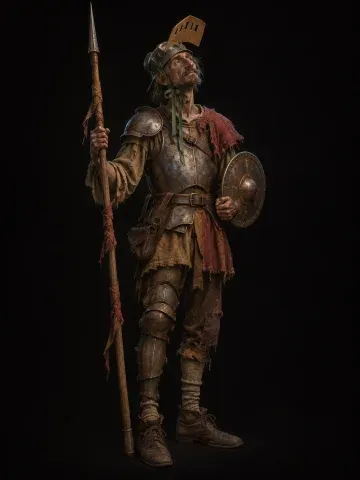
Don Quixote
A gentleman of La Mancha who models his life on books of chivalry and rides out to defend the helpless. Courageous, generous, and dangerously certain of his visions, he seeks honour and the favour of Dulcinea.
Lines worth keeping
Don Quixote Part 1, Chapter 14 quotes
But supposing the beauty equal on both sides, it does not follow that the inclinations must be therefore alike, for it is not every beauty that excites love, some but pleasing the eye without winning the affection; and if every sort of beauty excited love and won the heart, the will would wander vaguely to and fro unable to make choice of any; for as there is an infinity of beautiful objects there must be an infinity of inclinations, and true love, I have heard it said, is indivisible, and must be voluntary and not compelled. If this be so, as I believe it to be, why do you desire me to bend my will by force, for no other reason but that you say you love me?
I was born free, and that I might live in freedom I chose the solitude of the fields; in the trees of the mountains I find society, the clear waters of the brooks are my mirrors, and to the trees and waters I make known my thoughts and charms. I am a fire afar off, a sword laid aside.
Check yourself
Part 1, Chapter 14 questions
-
How does Ambrosio explain the jealousy and suspicion expressed in Chrysostom’s poem?
- Chrysostom’s voluntary separation from Marcela had stirred imaginary fears.
- Marcela had broken a promise to meet Chrysostom after his return.
- Chrysostom had discovered that Marcela intended to marry another shepherd.
- Marcela had encouraged several suitors while concealing them from Chrysostom.
Answer
A. Chrysostom’s voluntary separation from Marcela had stirred imaginary fears.
-
What had Marcela told Chrysostom when he declared his intentions?
- She intended to spend her life in solitude.
- She intended to leave the mountains before choosing a husband.
- She would consider marriage once he had proved his patience.
- She would accept him if her other suitors withdrew.
Answer
A. She intended to spend her life in solitude.
-
How does Don Quixote respond when some men try to follow Marcela?
- He threatens anyone who follows her and defends her right to be left alone.
- He offers to lead the men after her so they can hear a further explanation.
- He urges her to remain nearby until the mourners have finished the burial.
- He asks Ambrosio to follow her and persuade her to return to the funeral.
Answer
A. He threatens anyone who follows her and defends her right to be left alone.
Read all of Part 1, Chapter 14 with the voice
The whole chapter and the rest of Don Quixote wait in the Lightkeeper app, on iPhone and Android.