
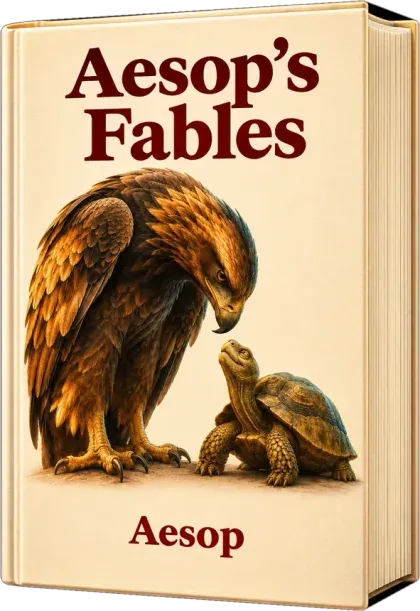
Aesop
Aesop's Fables
A Fox stands beneath grapes he cannot reach; a Crow holds a morsel someone else desires; a poor Woodman loses the tool by which he lives. In Aesop’s fields, woods, and villages, every appetite invites a trial, and every promise may conceal a trap. Lions need mercy, mice need courage, and people who dream of riches may destroy the little wealth they have. These brief encounters turn familiar creatures into unsettling companions, exposing the vanity, greed, and generosity that still govern ordinary life. When strength, cunning, and honesty meet on the same narrow path, which will bring its owner safely home?
- Reading time
- About 2 h 30 min
- With the voice
- 3 h 31 min
- Length
- 39,602 words · 5 chapters
- Level
- B2 CEFR
Read the opening · Chapter 1 · 8 min
“A hungry Fox saw some fine bunches of Grapes hanging from a vine that was trained along a high trellis, and did his best…”
The first minutes of Chapter 1, the way the Lightkeeper app reads it: one line of words past an amber letter, with the voice. Switch to Page to see the whole paragraph.
End of the opening
Chapter 1 goes on in the app.
You caught 0 gems. The rest of the book waits in the app.
Text: Aesop. Tap the ribbon to pause; tap while a line shimmers to catch it.
Who’s who
Aesop's Fables characters
-
Fox
Quick-witted and hungry, the Fox seeks food, advantage, and escape through persuasive speech. His encounters reveal both the usefulness of cunning and the excuses wounded pride invents.
First named in Chapter 1
-
Lion
The Lion appears in several tales as a figure of strength, appetite, and authority. His dealings with weaker creatures test what power can demand and when it must depend on help.
First named in Chapter 1
-
Ass
Often burdened with work or tempted beyond his station, the Ass seeks relief, fair treatment, or recognition. His vulnerability brings him into sharp encounters with stronger and more calculating creatures.
First named in Chapter 1
-
Mercury
Mercury intervenes when a Woodman loses his axe. His dealings with those who seek his assistance turn upon their honesty.
First named in Chapter 1
-
The North Wind
Fierce and confident in his strength, the North Wind competes to make a traveller remove his cloak. He expects force to accomplish his purpose.
First named in Chapter 1
-
The Sun
The Sun takes up the same challenge as the North Wind, bringing warmth to bear upon the traveller. His quiet influence offers another way to move a stubborn will.
First named in Chapter 1
-
Tortoise
The Tortoise enters a race against the much swifter Hare. She relies on steady movement despite the apparent inequality of the contest.
First named in Chapter 2
-
Hare
The Hare possesses the speed his rival lacks and places great confidence in that advantage. He approaches their race certain that time is on his side.
First named in Chapter 2
In the app you can talk to 5 of the characters. They answer from the page you’re on, so the story ahead stays yours to find. How it works
What happens
Aesop's Fables summary
Spoilers below.
The Price of a Morsel
Beneath a cluster of grapes, a hungry Fox leaps and fails, then walks away declaring the fruit sour. Elsewhere, his tongue serves him better: he praises a Crow until she opens her beak to sing, and her cheese falls into his keeping. Desire finds a hundred disguises. A couple cut open their golden-egg-laying Goose, seeking all their fortune at once, and discover that they have killed its source.
Yet the small and helpless have their powers. A Mouse gnaws through the bonds of a Lion who once spared him. A fugitive Slave draws pain from another Lion’s wounded paw; when they meet again in the arena, recognition overcomes hunger, and both receive their freedom. Beside the water, Mercury restores an honest Woodman’s axe and adds silver and gold. An imitator reaches eagerly for the golden prize and loses even the help he sought.
The North Wind tears at a traveller’s cloak; the Sun warms him, and the cloak comes off willingly. But gentleness cannot mend every folly. A Milkmaid’s imagined fortune spills with her milk, and a Shepherd’s Boy cries for help at last to ears his lies have closed. Meanwhile, sons digging for their father’s buried treasure find their reward growing on the vines.
Inside the book
5 chapters
- Introduction
- Chapter 1 A hungry Fox spies Grapes high on a trellis, but how can he turn temptation into a meal?
- Chapter 2 The animals crown a Monkey for his dancing, but the Fox sees little reason to celebrate.
- Chapter 3 The Oxen sharpen their horns for revenge, but one old Ox has doubts about their plan.
- Chapter 4 A Wolf offers a Goat advice from the foot of her rock, but why is he so concerned for her safety?
- Chapter 5 Some Dogs find a lion’s skin and sink their teeth into it, drawing the attention of a passing Fox.
Lines worth keeping
Aesop's Fables quotes
A hungry Fox saw some fine bunches of Grapes hanging from a vine that was trained along a high trellis, and did his best to reach them by jumping as high as he could into the air. But it was all in vain, for they were just out of reach: so he gave up trying, and walked away with an air of dignity and unconcern, remarking, “I thought those Grapes were ripe, but I see now they are quite sour.”
At last one of the Frogs put his head out of the water and said, “Oh, stop! stop! I beg of you: what is sport to you is death to us.”
Persuasion is better than force.
Slow and steady wins the race.
In the earliest human history whatever is authentic is universal: and whatever is universal is anonymous.
This is the immortal justification of the Fable: that we could not teach the plainest truths so simply without turning men into chessmen. We cannot talk of such simple things without using animals that do not talk at all.
ThemesCunning and self-deceptionPower and vulnerabilityGreed and its lossesKindness and reciprocityPrudence and steady effortResponsibility for one’s choices
Questions
Before you start
How long does it take to read Aesop's Fables?
Aesop's Fables is 39,602 words. At an average adult pace for fiction, about 260 words a minute (Brysbaert, 2019), that’s about 2 h 30 min. With the voice at normal speed it takes 3 h 31 min, and about 2 h 21 min at 1.5×.
Is there a Aesop's Fables audiobook with the text?
Yes. In Lightkeeper the voice reads while the words move past one amber letter, so your eyes and ears stay on the same word. Speed it up or slow it down and the voice keeps pace. The opening of Chapter 1 is on this page to try.
What reading level is Aesop's Fables?
B2 on the CEFR scale, which runs from A1, the easiest, to C2.
Read all of Aesop's Fables in Lightkeeper
With the voice, the gems to find and the characters to talk to. On iPhone and Android.
More from the shelf
You might read next
-
 Peter Pan J. M. Barrie 4 h 30 min · B1
-
 Black Beauty Anna Sewell 5 h 10 min · B1
-
 The Wonderful Wizard of Oz L. Frank Baum 3 h 35 min · B1
-
 The Happy Prince and Other Stories Oscar Wilde 4 h 25 min · B1
-
 Through the Looking-Glass Lewis Carroll 2 h 50 min · B1
-
 A Christmas Carol Charles Dickens 2 h 50 min · B1